
For the better part of thirty years I sharpened chisels on whatever was within reach. First a gray oilstone that came out of my father's toolbox. Later, a sheet of wet-or-dry paper clamped to a scrap of glass, because the oilstone had gone hollow in the middle and I was too stubborn to replace it. Both methods worked. Neither worked fast. A dull chisel will still cut, it just makes you push harder for a worse joint.
About two years ago I bought the HURRICANE 4-piece chisel set to replace a mismatched drawer full of hardware-store chisels. Within a month the new ones were cutting worse than the old ones, and it was not the chisels' fault. I had stopped honing, because honing meant dragging out the paper and the glass and cleaning up afterward. So that same month I bought the SHARPAL 162N, an 8 inch by 3 inch double-sided diamond stone, and set it on the rolling sharpening cart beside my bench. That cart is half the reason this worked. I will come back to it.
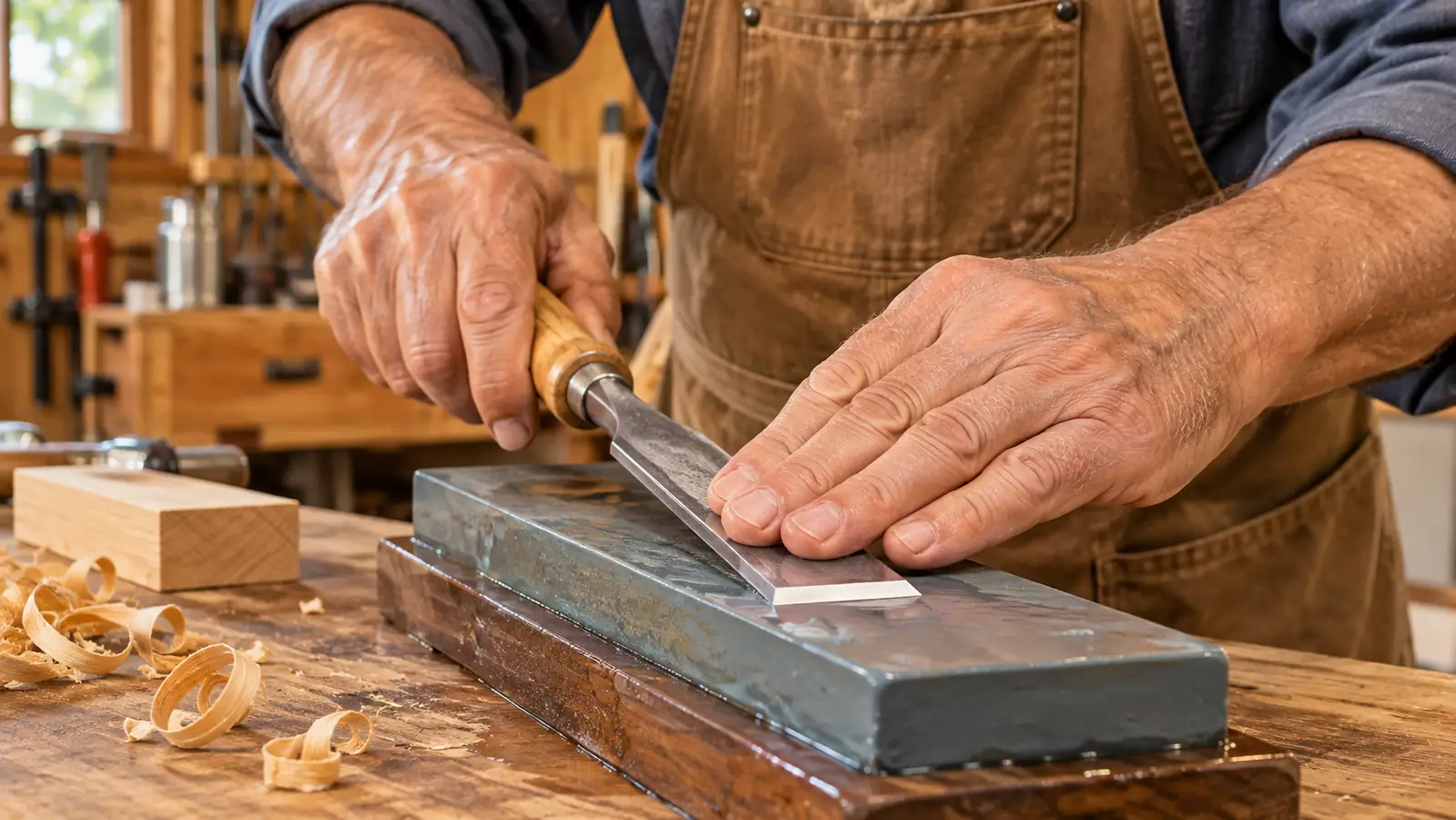
The stone has two faces. Coarse is 325 grit, 45 micron. Extra fine is 1200 grit, 12 micron. The diamonds are electroplated onto a stainless steel base that measures 0.35 inch thick, and the whole stone weighs a little over three pounds, so it sits still on the cart instead of skating around while you push a chisel across it. The SHARPAL is a heavy little thing in the hand, and that weight is doing real work for you.
The first chisel I put to it was a 3/4 inch that had picked up a nick during a hinge mortise where I got impatient. On the coarse side, somewhere around a hundred and fifty strokes, the nick was gone and the edge was square again. Then twenty passes on the fine side to hone it. I checked the back against the straightedge of my combination square and it was flat. Total time, under ten minutes. That was the afternoon I stopped thinking of sharpening as a chore and started thinking of it as the first step of the project.
What changed in the actual work was not dramatic. My dovetails did not suddenly look like a magazine photograph. But the gaps got smaller. Pine stopped crushing at the baseline. When I built a picture frame for my daughter that spring, the miters closed without a fight, because the chisel I used to clean out the corners was genuinely sharp instead of approximately sharp.
A hundred and fifty strokes on the 325 side took a nick out of a 3/4 inch chisel. Twenty passes on the 1200 side brought it back to shaving. Under ten minutes, start to finish.
The stone that ended thirty years of sharpening excuses
Two grits, a stainless base that stays put, and a storage box with a non-slip pad that doubles as a sharpening base. This is the one sitting on my cart right now.
Amazon Check Today's Price on Amazon →The block plane iron gets the same routine. The JORGENSEN No. 60-1/2 lives on the shelf above the bench, and when it starts tearing end grain instead of slicing it, I know it is time. Coarse side first if there is a ding, fine side only if there is not. Two minutes, and it goes back on the shelf. Before the stone I was touching up that iron with sandpaper on a glass plate and telling myself it was good enough.
One thing I do not do is run the SUIZAN pull saw across it. A ryoba is a thin plate with teeth set on both edges, and dressing those teeth is a separate job with separate files. The stone stays with the flat work: chisels, plane irons, and the occasional kitchen knife if Carol catches me in a good mood.
Two years of steady use, and here is what I can tell you about the SHARPAL. The face has not gone hollow the way my father's oilstone did. Diamond does not dish out the way a soft stone does, because you are not wearing away the stone, you are wearing away the steel. I have never had to flatten it. I rinse it, dry it, and put it back in the box.
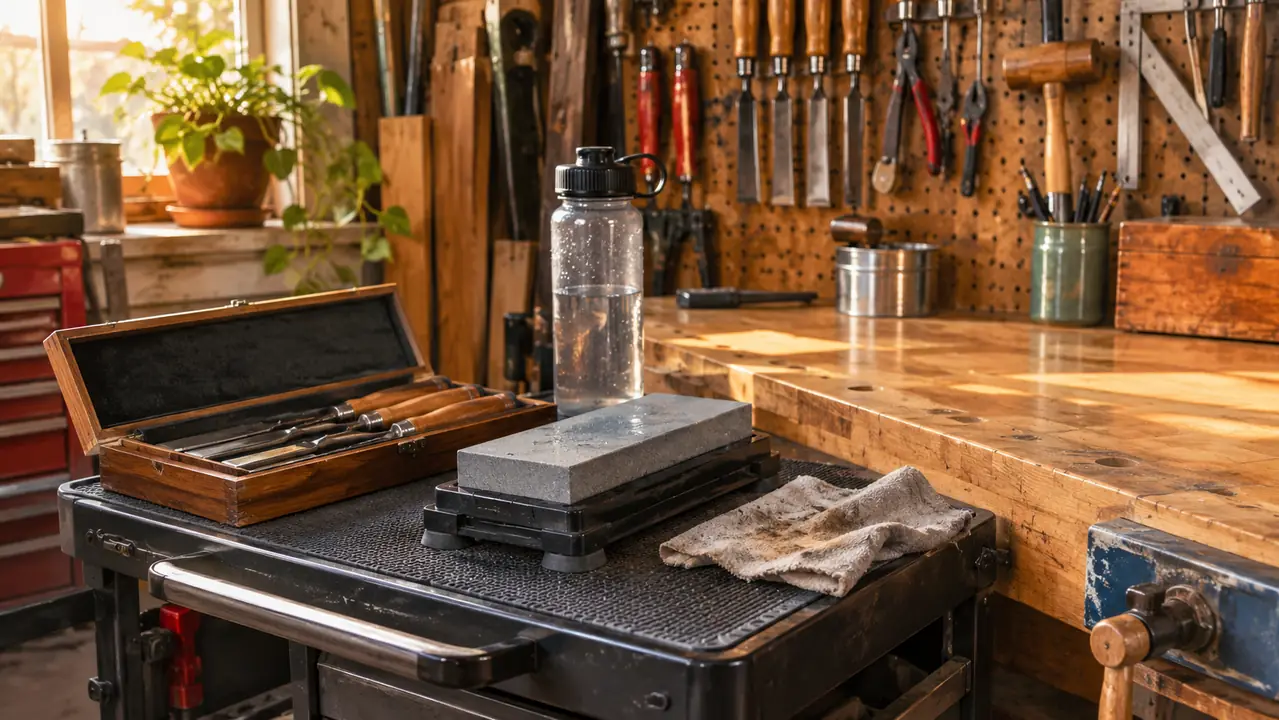
That box is worth a sentence, because it is not an afterthought. The stone comes in a storage case with a non-slip rubber pad, and the pad doubles as a base you set the stone on while you work. On the cart it matters less. When I carry the stone over to the bench for a longer session, the pad keeps it from walking. Small thing. It is usually the small thing that decides whether a tool gets used or ends up in a drawer.
The tradeoff is the finish. A 1200 grit diamond face leaves an edge that is plenty sharp for chisels and planes, but it is not the mirror polish you get from a finishing waterstone. If you are the sort of woodworker who chases a polished bevel under a loupe, you already know that and you already own those stones. For the rest of us, the edge off the fine side cuts pine end grain clean and holds through a set of mortises. That is the job.
It is also quick, and quick is the whole point. The reason my chisels went dull in the first place was that sharpening took longer than I was willing to give it. A stone that lives on a cart, needs a splash of water, and hands you a working edge in two minutes gets used. A stone in a cabinet does not. The SHARPAL earned its spot on the cart by being faster to reach for than to avoid.
What I'd Tell You If We Were Sitting at My Kitchen Table
I would tell you that you are not really buying a stone. You are buying the habit of using one. Keep it out where you can reach it without moving anything else. Mine sits on the cart beside the chisel box, and that is why it sees use two or three times a week instead of once a season. If you know in your heart it is going to live in a drawer, save your money, because neither this stone nor any other will tighten a joint from inside a drawer.
I would tell you to use the coarse side without guilt. New woodworkers tend to baby a new stone and only touch the fine face. The 325 side is there to do the real work when an edge is damaged, and using it is not abuse. The 1200 side is for afterward, twenty passes, and you are done.
And I would tell you that better chisels will not fix a rounded edge. I learned that the expensive way with the HURRICANE set. A diamond stone you actually reach for will do more for your work this year than any tool hanging on the wall behind it.
Put it where you can reach it, then use it
Coarse 325 for setting an edge, extra fine 1200 for honing, a stainless base that stays put, and a case with a non-slip pad that works as a base. Two years on my cart and still flat.
Amazon Check Today's Price on Amazon →