

The chisels I had before these came from three different hardware stores, and the only thing they had in common was that none of them kept an edge past one afternoon. I would hone one, pare a couple of hinge mortises, and be back at the stone before the job was finished. Two years ago I bought the HURRICANE 4 piece wood chisel set to end that loop. Nobody sent it to me. I paid for it, opened the case on my own bench, and put those four chisels to work on cutting boards, picture frames, step stools, and a bookshelf for my granddaughter.
What follows is what two years of weekend use in one garage shop actually looks like. Not a first impression unboxing, and not a comparison against a set that costs four times as much. Just an honest account of what the HURRICANE chisels do well, where they annoy me, and who should spend the money. If you are setting up a first bench or replacing a mismatched drawer of old chisels, this is the shape of what you would be getting.
The Quick Verdict
Four CR-V bench chisels in a molded case that has done more for my edges than any sharpening habit I ever had. Plan on twenty minutes with a stone before the first project and you will get years out of them.
Amazon Check Today's Price →The set that ended my coffee can problem
If your chisels go dull before the job does, four sizes from 1/4 inch to 1 inch in one case is the cheapest fix I know of. That is what I did two years ago and I have not gone back.
Amazon Check Today's Price on Amazon →How I've Used It
The set lives in its own box in the top drawer under my bench, which sounds like a small thing until you have spent twenty years digging a chisel out from under a tape measure. Both of my earlier sets lived loose in a coffee can. Every time I pulled one out, the edge had found something to bang against on the way. The case that comes with this HURRICANE set is nothing fancy, molded plastic with a slot for each blade, and it has protected my edges better than any sharpening habit I have ever managed to keep. I open it, take out the one I need, and put it back.
Most of my work with these is paring. Dovetails on a blanket chest, mainly, and cleaning out hinge mortises when I hang a cabinet door. The 1/4 inch does the hinge work, because a mortise is narrow and the corners need a chisel that gets in and out without bruising the sides. The 1/2 inch is the one I reach for without thinking, chamfering an edge or shaving a high spot off a glue joint. The 3/4 and the 1 inch come out for wider work, cleaning up a rabbet or trimming the end of a board that sits a hair proud of the one beside it. Nothing glamorous. It is the work that decides whether a joint looks like furniture or like a first attempt.
For a while I had a routine that was worse than no routine at all. I would grab whichever chisel sat closest, use it, and set it down on the benchtop wherever I happened to finish the cut. Then I would burn five minutes at the start of the next session hunting for it under a shop rag. Three or four weekends of that was enough. The case fixed a habit problem I did not know I had. The sizes sit left to right, small to large, and my hand goes to the right slot without me looking down. That sounds trivial until you have made the same reach forty times in an afternoon and never once had to think about it.
Two years in, they are not my only chisels. I still keep one wide old chisel for scraping glue and prying the lid off a finish can. But this is the set I reach for, and the reason is boring: four sizes, each one where I expect it to be, and an edge that survives a weekend instead of an hour.

What the Steel and the Bevel Actually Do
The blades are drop forged CR-V steel with a 25 degree bevel. That number matters more than the steel name does for a shop like mine. Twenty five degrees is a compromise angle, and a good one for what most of us do. It is steep enough to survive red oak without folding over, and shallow enough that it still cuts pine and poplar cleanly instead of skating across the surface. A shallower edge would feel sharper in softwood and would start chipping the first time I took it to a hard maple cutting board. A steeper edge would hold up longer and leave me pushing harder to get through a paring cut. Twenty five sits where I want it.
I checked the bevel angle against my combination square the first week, out of curiosity more than doubt. All four came in at the same angle, right around the mark, which is not something I would have bet on from a set in this bracket. What surprised me more was how even the grind felt. I ran a thumb down each bevel and could not find a low spot or a wire edge left over from the factory. Years ago I owned a set where two of the three blades had a hollow in the middle of the bevel, and I chased that hollow on the stone for an hour before giving up and regrinding the whole thing. None of that here.
The listing calls the bevel multi-purpose for softwood, hardwood and laminated stock, and that matches what I have seen. I have used these on pine from the home center, poplar for painted picture frames, red oak for a step stool, and one walnut board I paid too much for and cut very slowly. No chipping on the oak. On the walnut I was careful anyway, because I am always careful with walnut. The bevel is flat and even across all four blades, which tells you something was ground on a machine rather than at the end of somebody's shift.
The backs were a different story. Two of the four needed real work on the coarse side of my stone before the back sat flat, and the 1 inch took the longest. That is normal at this level and I would rather say it than pretend otherwise. Fifteen minutes with a diamond stone and they were where I wanted them, and none of the four has moved since.
Two Years on the Same Edge
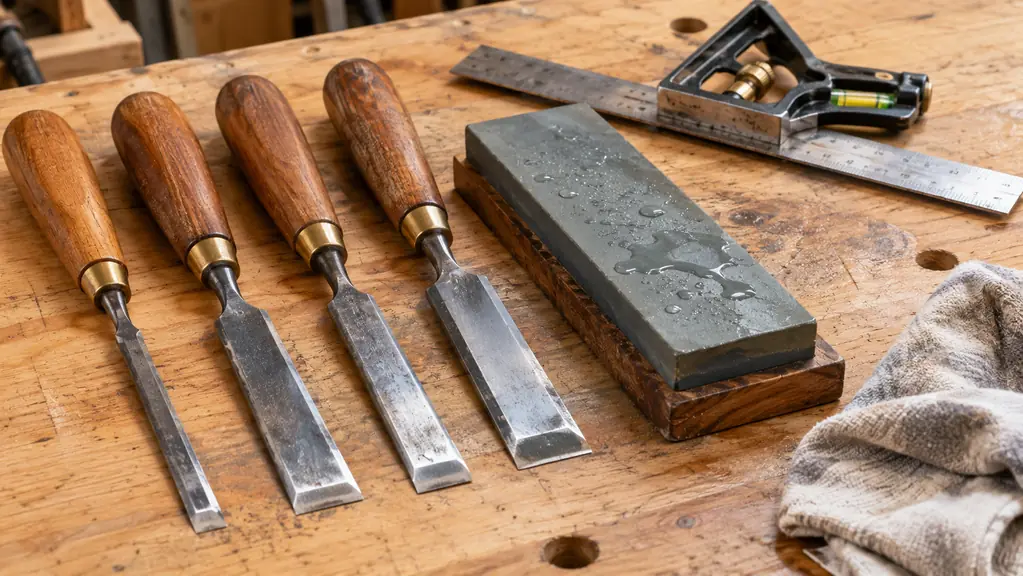
I sharpen on a SHARPAL 162N diamond stone I bought the same month as the chisels, with water and no oil. Coarse side for flattening and for fixing a nick, fine side for the weekly touch up. The routine is a few passes on the bevel, the back flat on the stone, and back in the box. That is it. I am not a person who chases a mirror polish, and for the work these do I do not think you need to either.
One thing I got wrong at first was how much pressure to use on the stone. I was bearing down on it like I was sanding a tabletop, and the edge came up rounded instead of flat. Carol heard me grumbling about it through the kitchen door and asked what I had broken now. What fixed it was backing off to almost nothing, letting the diamond grit do the cutting, and counting passes instead of guessing at them. Ten on the bevel, five flat on the back, then check it against my thumbnail. That thumbnail test has saved me more fuss than anything else on the sharpening cart.
How often? During a cutting board session I will touch up the 1/2 inch maybe twice. Across a weekend of paring dovetails, once at the start and once more if the shavings start coming off dusty instead of curling. Two years of that and the two smaller blades have lost a thirty-second or so of width, which is what happens to any chisel you actually use.
The only real damage came from me. I dropped the 1/2 inch on the garage floor last spring and put a nick in the edge about the width of a pencil tip. Twenty minutes on the coarse side and it was gone. That is the test that matters for a hobby set: can it come back from stupid? These did, and without me swearing at them.
The Handles, the Guards, and the Case
The handles are high impact PVC and the grip is what the listing calls regular, which fits my hand fine. I wear a medium glove. If you have very large hands, the smaller two will feel like holding a pencil, and that is true of any 1/4 inch chisel on the market, not just this one. What I care about is whether I know where the bevel is pointing without looking. After a few weeks with these I did, and that is the whole job of a handle. My one complaint is that the PVC turns slick when my hands are damp, and if I could change one thing about the set, that would be it.
The handles have picked up a few scuffs, mostly from riding in the drawer, and the 3/4 inch has a smear of stain on it from a batch of picture frames where I got careless with the rag. I have not bothered to clean it off. It does not affect the grip and it reminds me which chisel I used for those frames. Two years of weekend handling has not loosened a single handle, and that was my real worry buying a set in this bracket. It is the worry that turned out to be misplaced.
Blade guards ship on all four, and I still put them on when a chisel leaves the box for a job away from the bench. They are simple caps and they do the one thing they are for. The case itself is the piece of this set I would call basic. Molded plastic, hinge molded in, a latch that works and has not popped open in a drawer for two years. It is not a presentation box. It is a container that keeps four edges away from each other, and that is all I asked of it.
Where It Falls Short
If you are cutting timber frame joinery or chopping deep mortises in white oak with a two pound mallet, this is the wrong set and you probably already know it. These are bench chisels with PVC handles, and nothing in the listing describes a steel striking hoop, so I am not going to tell you to pound on them. I pare with hand pressure, and on the rare occasion I want help I use the lightest taps from a small mallet. Anything heavier is asking the handle to do a job it was not described as doing, and I would rather you hear that from me than from a split handle.
The size range is the other limitation. Four sizes from 1/4 inch to 1 inch cover most bench work, and I have never once wished for something between them. What I have wished for is a 1/8 inch for cleaning out a narrow groove, and something around 1-1/2 inch for paring a wide tenon cheek. Neither is in this set and neither is a deal breaker at this level. You buy a second chisel when a project demands it.
The last thing is the edge out of the box. Mine arrived sharp enough to cut pine and not sharp enough to satisfy me on oak. Plan on twenty minutes with a stone before your first real project. If that sentence irritates you, buy a set that costs several times more, because every set at this level needs the same twenty minutes. The difference is whether the steel holds what you give it. This steel does.
What I Liked
- Four sizes, 1/4 inch through 1 inch, cover nearly all bench paring and hinge work
- CR-V blades with a 25 degree bevel hold up on oak and take a fresh edge quickly on a diamond stone
- Molded case with a slot per blade keeps edges from knocking together in a drawer
- PVC handles are comfortable and let you feel where the bevel points within a few weeks
- Blade guards are still in service two years on and travel with the chisel
- Four blades for less than the cost of one premium chisel, which matters when you are starting out
Where It Falls Short
- Backs on two of the four needed flattening on a coarse stone before first use
- Not built for mallet chopping, and the listing makes no striking hoop claim
- No 1/8 inch and nothing wider than 1 inch
- Out of box edge is serviceable on pine but needs honing before hardwood work
- The case is basic molded plastic with no room for a fifth chisel
The 1/4 inch gets into a hinge mortise, cleans the corners square, and comes out without bruising the sides. That one chisel is why I stopped dreading hanging a door.
Who This Is For
This set is for the person who has a bench, a couple of power tools, and a growing pile of projects that need a clean paring cut. If you are building step stools, picture frames, small boxes, a bookshelf for a grandchild, and you want four honest bench chisels that will hold an edge through a weekend, this is the sensible buy. It is also the right first set for someone setting up a bench who does not yet know which sizes they will favor. Four chisels tell you that fast, and the cost of finding out is small. Pair it with a diamond stone and you have everything the hand work needs.
Who Should Skip It
Skip it if you chop mortises with a mallet all day, if you are doing timber frame work, or if you want a chisel you can hand down. Skip it if a twenty minute honing session on a new tool makes you feel cheated rather than set up. And skip it if you already know your work lives in one size, because buying four to use one is not a bargain. For everyone else with a garage bench and a Saturday, the HURRICANE set has earned its spot in the top drawer, and it took two years and one dropped chisel to prove it.
Four chisels that survive a weekend instead of an hour
Two years on the same four blades, one nick repaired, one case still shutting. If that sounds like the set you have been meaning to buy, the current price is worth a look before your next project.
Amazon Check Today's Price on Amazon →