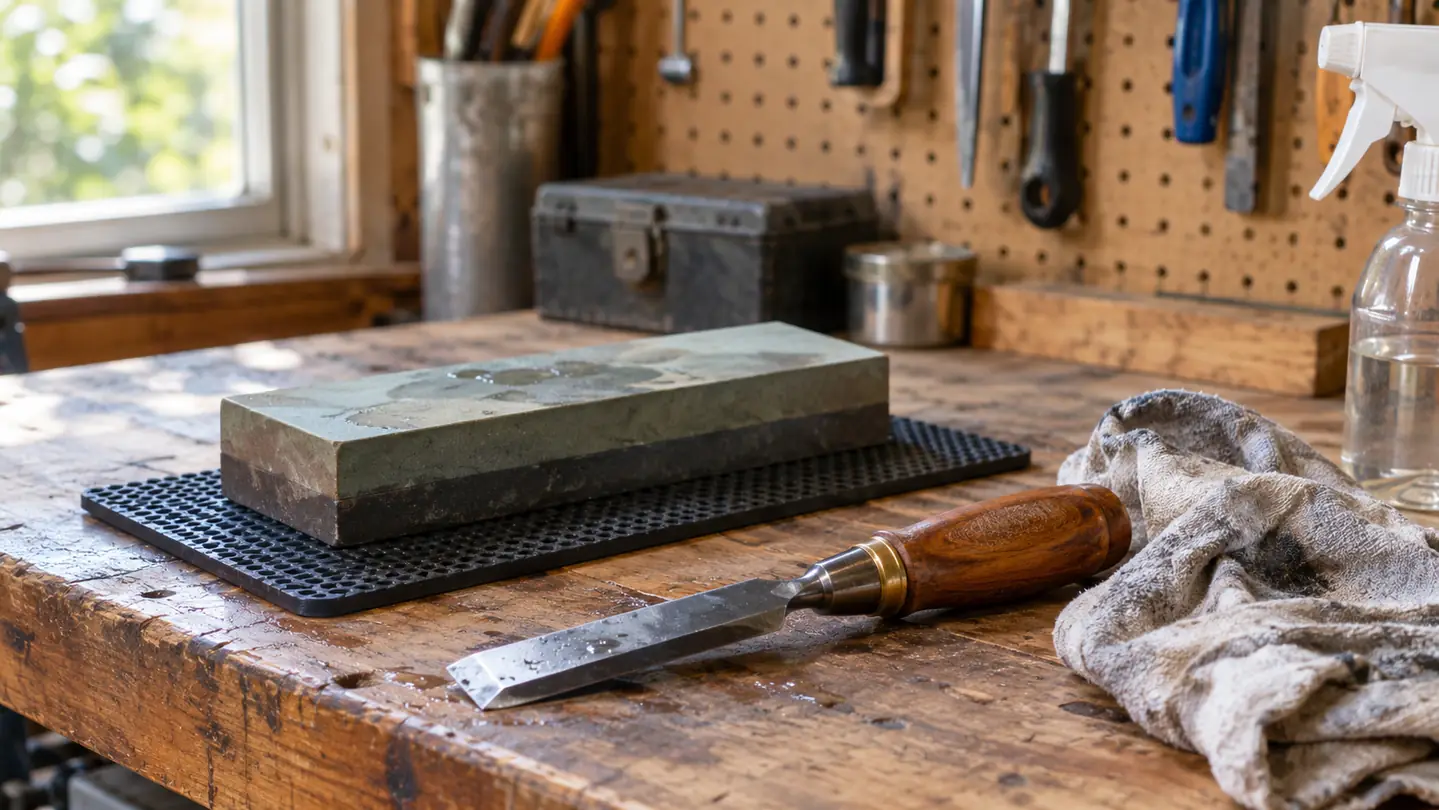
I own four chisels that cut like butter and one that cuts like a spoon. The difference has never been the name stamped on the steel. It is whether the edge got touched up before the last project or after it. For years I kept an old oilstone in a coffee can of kerosene and told myself that was a sharpening system. It worked, sort of, until the middle of the stone wore low and every chisel came off it with a curved edge I could not chase out. About two years ago I bought a SHARPAL 162N double-sided diamond stone, the 8 inch by 3 inch one, and set it on the rolling cart next to the bench. It has not left the cart since.
This is not a piece where I pretend a sharpening stone changed my life. It is a list of ten things that stone actually does in a garage shop like mine, in roughly the order I noticed them, plus a straight answer about where it stops being the right tool. If you are setting up a first bench, or you are tired of buying chisels that arrive sharp and never come back, this should save you some guessing.
Two grits, one plate, and a chisel that finally does what you ask
The 325 grit side sets an edge. Flip it and the 1200 grit side hones it. No soaking, no second stone to buy.
Amazon Check Today's Price on Amazon →Two grits on one plate, so you stop walking between steps
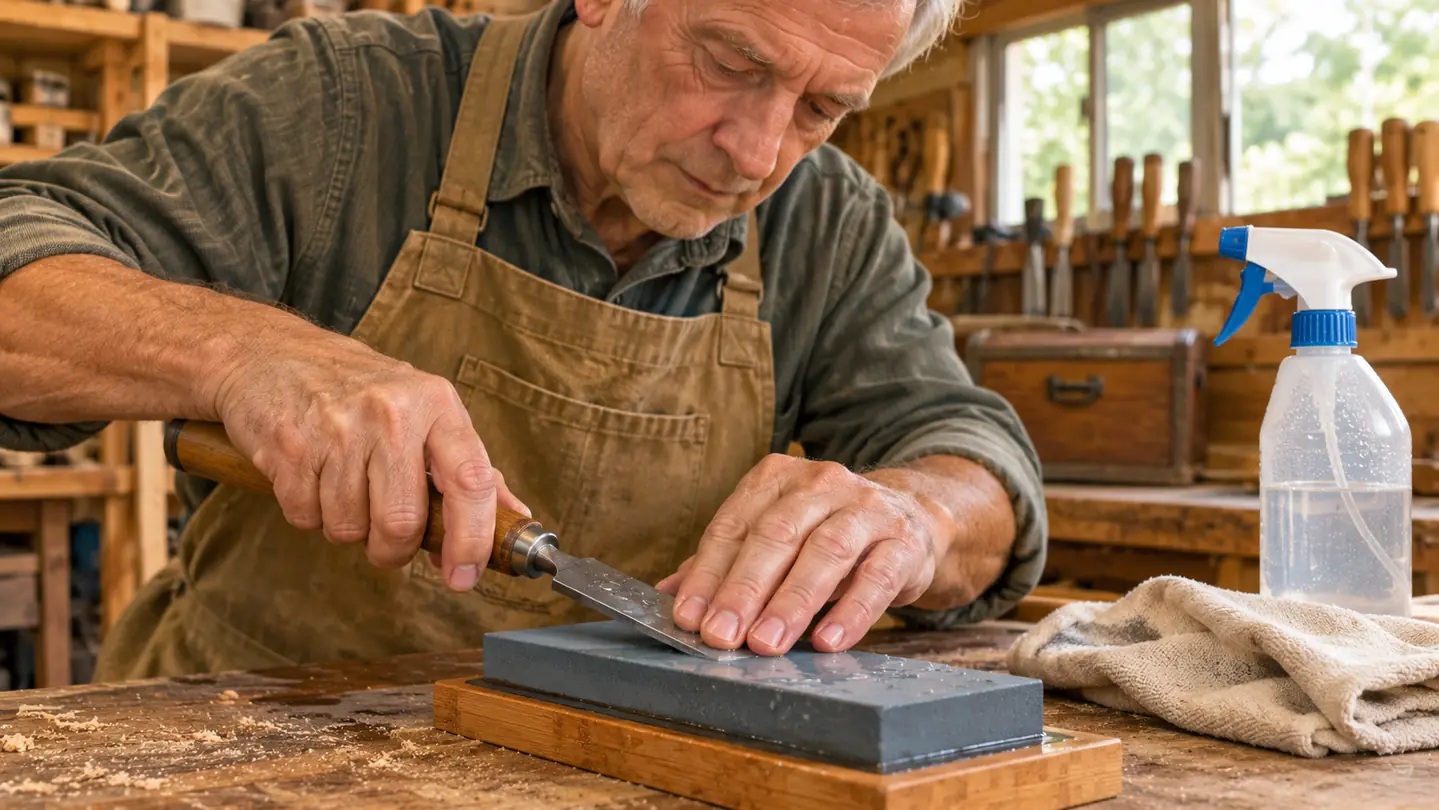
The coarse side is 325 grit, about 45 micron, and it is for setting a bevel or taking out a nick. The extra fine side is 1200 grit, about 12 micron, and it is for honing. Having both on one plate means I do not cross the garage between steps. Coarse to set the angle, flip the stone in its box, fine to polish the edge, then check the burr with a thumb. Three minutes on a chisel that only needed a touch up.
It never dishes, so you never have to flatten it
The reason my old oilstone failed is simple. Steel wears stone. The middle goes low, the edges stay high, and every chisel ends up with a bevel you cannot fix by pressing harder. Diamond does not do that. The abrasive is monocrystalline diamond, electroplated onto a steel plate, and it wears at a rate you will not notice in a home shop. Mine is two years old and still sits flat against a straightedge. That alone is worth the shelf space.
It cuts the hard steels that laugh at oilstones
Some newer chisels and plane irons are hard enough that a soft oilstone just skates across them. My low-angle block plane iron is one of those, and a couple of chisels in my set are close behind. The SHARPAL takes them without drama. Coarse side first, and you can feel it biting instead of sliding. That was the whole reason I went looking for a diamond stone, and it is the reason I would buy another.
Water only, so no oil can, no smell, no rag going stiff
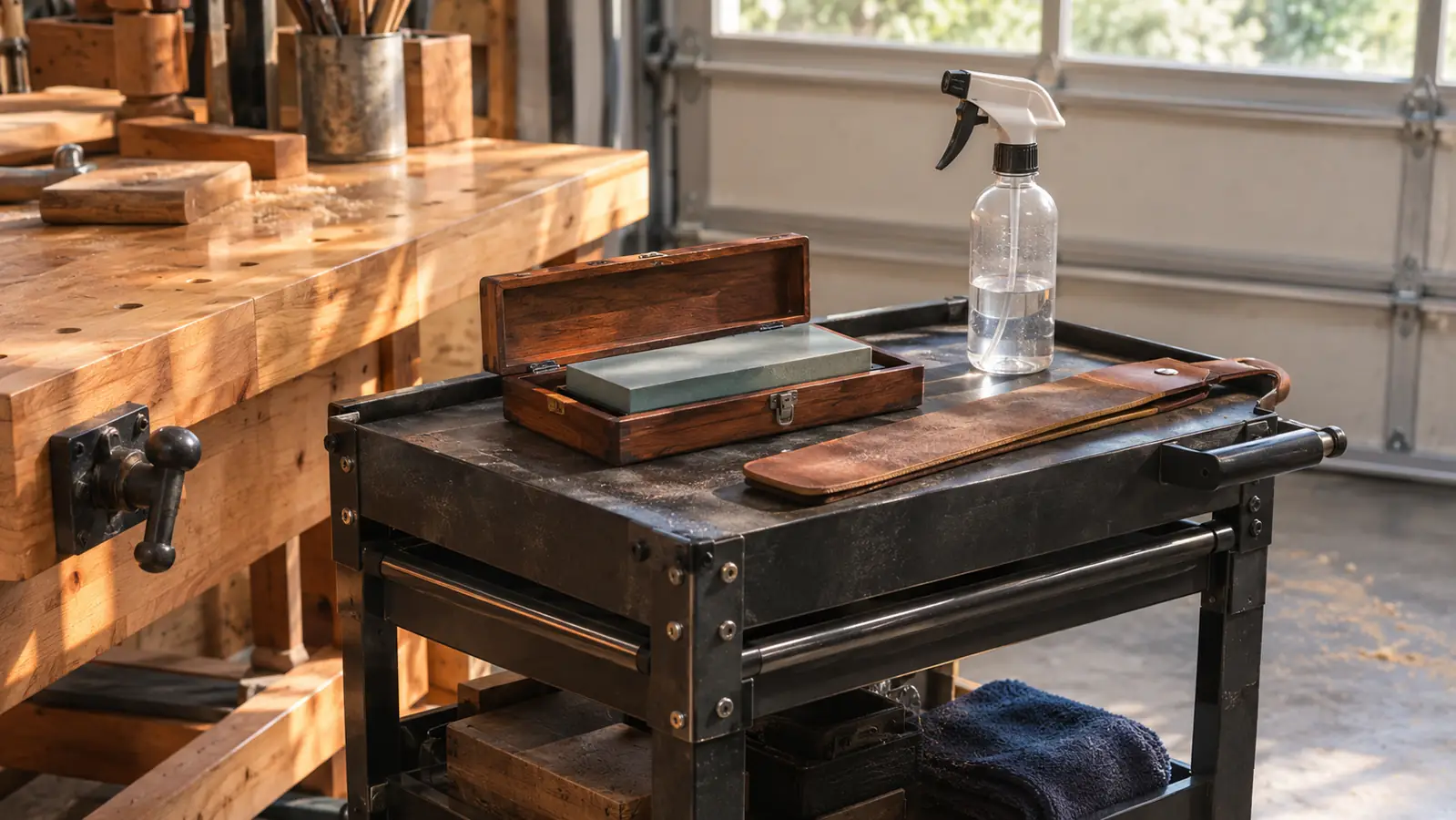
The instruction is water. I keep a small spray bottle on the cart, give the surface two or three squirts, work, then wipe it dry with a rag and put it back in the box. No kerosene can sitting on the bench. No oiled rag going stiff in the corner. No smell in a garage that shares a wall with the house. If you have ever knocked a can of sharpening oil over on a concrete floor, you already know why this is on the list.
The storage box doubles as the non-slip base
The stone comes in a plastic case with a rubber pad inside. That pad is the base, and the case becomes the holder. Set the pad on the bench or the cart, lay the stone on it, and it stays where you put it while you push a chisel across the surface. Sounds like a small detail. It is not. A stone that walks while you are honing a bevel will cost you the bevel, and then you start over.
The 0.35 inch stainless base does not flex under a wide iron
The base is stainless steel, 0.35 inch thick, which is heavier than the stamped plates I have handled at the flea market. That matters when you are pressing a wide iron flat. A plate that bows gives you a back that is not actually flat, and you will chase that error for an hour without knowing what you are chasing. This one is rigid enough that I stopped thinking about it sometime in the first month.
8 by 3 inches fits a plane iron instead of fighting it
The working surface is 8 inch by 3 inch, and the whole unit measures about 8.46 by 3.94 by 1.93 inch. Three inches wide means a 2 inch plane iron sits on it with room left over, and eight inches long gives you a full stroke rather than a scrub. I have used a small diamond card on plane irons. It is fine for a pocket knife and miserable for anything wider than your thumb.
No soaking, so sharpening happens before the project
Water stones want ten or fifteen minutes in a tub. When you are squeezing a glue-up into a Saturday afternoon, that is enough friction to make you skip the honing altogether, and then you spend the project working around a dull edge. I spray the SHARPAL, hone, wipe, done. The stone gets used because using it is not a chore. That is a bigger deal than any spec on the box.
Fixed grits teach you what a burr feels like
Because the grits do not change and the plate stays flat, the results repeat. After a few weeks I could tell by feel when the burr had rolled over on the 325 side and when the 1200 side had taken it off. That feedback is hard to get from a dished stone, because you are never sure whether the problem is your wrist angle or the surface. Consistent tool, consistent lesson.
One stone covers chisels, plane irons and the shop knives
Chisels, the block plane iron, the utility knife I cut sandpaper with, the kitchen knives that follow me out to the garage, and a neighbor's pruning loppers last spring. That is a lot of ground for one item on a rolling cart. I am not claiming it is the only sharpening tool I own. I keep a strop, and I use it. But this is the one I reach for first and the one that handles the rough work.
The coarse side took a nick out of a one inch chisel in about four minutes. My old oilstone would still be grinding at it.
What I'd Skip
Two things I will tell you straight. First, this is not a polishing stone. If your idea of a finished edge is a mirrored bevel you can read a label in, the 1200 side gets you close and stops there. You want a strop or a finer stone after it, and I use both. Second, the coarse side is aggressive. Bear down on a narrow chisel and you can remove steel faster than you meant to, and you can scratch a back you spent an hour flattening. Light pressure, let the diamond do the cutting. I also would not hand this to somebody who has never sharpened anything and promise a perfect edge on day one. Freehand angle control is a skill, not a feature. The SHARPAL is a forgiving teacher, not an instant one, and the chisels do not care how much you spent on the stone.
If your chisels only need a touch up, this is the tool that gets reached for
Coarse 325 grit to set the edge, extra fine 1200 grit to hone it, water only, and a case that holds the stone steady while you work.
Amazon Check Today's Price on Amazon →A sharpening stone is not a glamorous purchase. Nobody walks into a garage and admires the stone. They admire a hinge mortise that came out clean because the chisel was sharp when you started. After two years on the cart, that is the case I would make for the SHARPAL 162N. It stays flat, it cuts the hard stuff, and it is easy enough to use that I actually use it. Everything else on this list follows from those three.