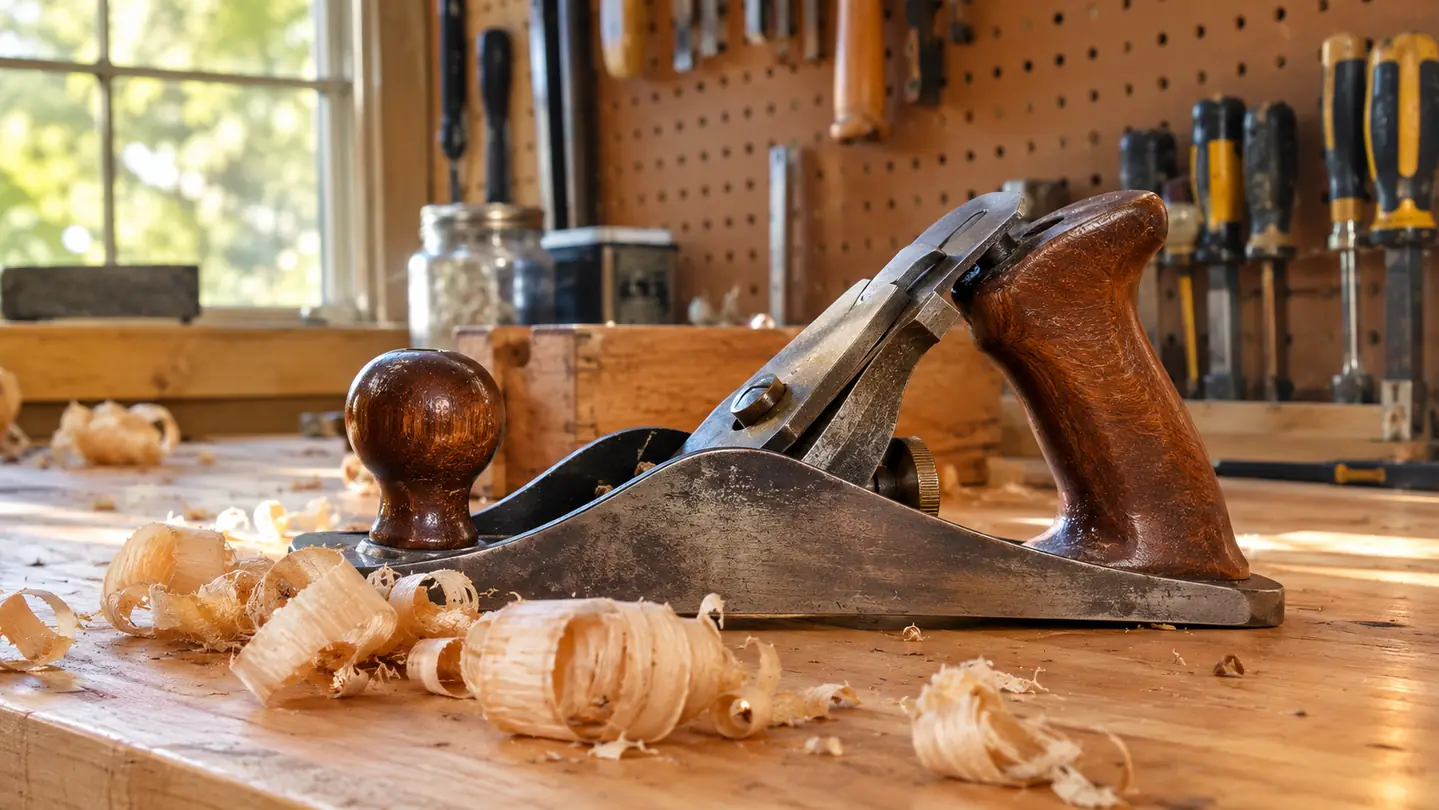
For two years I softened the sharp edges on everything I built with sandpaper wrapped around a scrap of pine. It worked, more or less. It also took three times as long as it should have, left edges that looked rounded instead of crisp, and ate through 120 grit doing a job a plane does in four passes. I bought the JORGENSEN No. 60-1/2 block plane about eighteen months ago to stop burning sandpaper, and it has lived on the shelf above my bench ever since, lying on its side the way you keep a tool you actually reach for.
That is eighteen months of chamfers, end grain and drawer fitting, not a weekend test. Long enough that the new tool shine is gone and I have stopped being generous with it. What follows is what the plane does well, where it makes me work harder than I want to, and the honest answer to whether a hobby woodworker with one bench actually needs it.
The Quick Verdict
A 1.5 pound cast iron block plane that takes a clean shaving on end grain and cuts an even chamfer once the O1 blade is honed. The depth knob takes a light hand, and the short sole means it trims rather than flattens.
Amazon Check Today's Price →The Tool I Reach For Before I Reach For Sandpaper
Cast iron base, O1 tool steel blade, 1.38 inch cut, 1.5 pounds. Six and a quarter inches of plane that cleans up the trimming jobs a table saw leaves behind.
Amazon Check Today's Price on Amazon →How I've Used It
The plane sits on the shelf above the bench, about a foot from my right hand, lying on its side so the blade is not resting against the cast iron. In eighteen months it has been used on pine, poplar, oak and a little walnut. Mostly it chamfers: the legs of two step stools, the corners of a blanket chest, the edges of maybe a dozen cutting boards. Chamfering is the job that sold me, because a plane cuts a chamfer with a consistent width while sandpaper cuts one that gets wider wherever you press harder.
The second job is end grain. I built a bookshelf for my granddaughter out of pine last year, and the table saw left fuzz and a little tear-out on the ends of the sides. Sanding that flat would have taken half an hour and rounded the corners. The block plane cleaned all four ends in about ten minutes, and the shavings came off in curls instead of dust. That was the moment the tool paid for itself in my head.
The third job is fitting. Drawer fronts on the chest, a couple of picture frame miters that needed a whisper taken off, a hinge mortise cleaned up after the chisel. Small corrections where a power tool is too much and sandpaper is too slow. What I do not use it for is anything bigger than that. Six and a quarter inches of sole is not going to flatten a warped board and it is not going to joint an edge. It is a trimmer, and I treat it like one.

What the Numbers on the Listing Actually Mean
The listing gives the plane as 6-1/4 inches long and 1.5 pounds, with a cast iron base and a blade made of O1 tool steel. Those are not marketing numbers, they are the two that decide how the tool feels. Six and a quarter inches fits in one hand with my index finger over the front, and 1.5 pounds is heavy enough to carry through a cut without me pushing down and light enough that a long chamfer does not wear out my wrist. It feels like a solid little block of metal, because that is what it is.
The cutting width is 1.38 inches. That matters more than it sounds. Wide enough to take a step stool leg in one angled pass, narrow enough to stay between the guide lines on a drawer side without the iron hanging over and gouging something. When I trimmed a set of picture frame miters, the width let me take the whole miter in two passes and check the fit, rather than four passes and hope.
The JORGENSEN blade is O1 tool steel, and that is the part I care about. O1 is a simple steel that sharpens easily and takes a fine edge. It will not hold that edge as long as some of the harder alloys on expensive planes, and I found that on oak I touch it up more often than on pine. For the work I do, easy sharpening matters more than edge retention, because a blade I can bring back in two minutes actually gets brought back.
Out of the Box and Onto the Stone
The plane came with the blade in it and, in my case, the blade was usable but not sharp. Most planes at this level arrive with a grinding mark or two and a bevel that will cut but will not sing. I took the blade out, worked the back flat on the coarse side of my SHARPAL 162N diamond stone with water, put a fresh bevel on the fine side, then finished with a few passes on the back to knock off the burr. Maybe fifteen minutes total, and the difference in the shaving was immediate.
Sharpening is the part that scares people away from hand planes and it should not. The blade is a simple flat piece of steel. You do not need a jig if you have a steady hand, and you do need to hold the bevel flat against the stone rather than rock it. I use water on the diamond stone, never oil, and I lay the blade bevel down with the flat side toward me so I can watch the scratch pattern move up the bevel as I work.
Setting the cut is done with the knob, and this is where technique matters. I turn it in small amounts, take a test pass on scrap pine, and adjust again. The first few times I tried to set it by eye and got a cut that was too deep, which jerked the plane in my hand. Now I set it shallow, cut, and sneak up on the depth. That is not a fault of the tool so much as the way a plane works, but it is worth saying plainly, because nobody tells beginners.
Where It Earns Its Place on the Shelf
End grain on pine and poplar is where a sharp block plane makes a power tool look silly. The cut is clean, the surface is smooth enough to finish straight from the plane, and there is no dust. My garage bay is about 11 by 20 feet and the neighbors are close, so a tool that makes shavings instead of noise and dust gets used more than one that does not. That is most of the reason this plane stays within arm's reach.
Chamfers are the second thing. A consistent chamfer all the way around a cutting board is one of those details that makes a gift look like it came from a store. I mark nothing. I take a few passes, count them, and do the same count on the next edge. The JORGENSEN's weight does the work and my hand just steers. When I did chamfers with sandpaper I could never keep the width even, and the corners had a soft look I did not like.
The last thing is quiet correction. Fitting a drawer front is a guess and check job. You take a shaving, you try the fit, you take another. With a power tool each try means noise, a cord, and a chance of taking too much in a heartbeat. With the plane I can take a shaving thin enough to see through. That is not a small thing. It is the difference between a drawer that fits and one that fits with a gap you notice every time you open it.
Where It Fights You
The depth knob has backlash. Turn it a quarter turn and nothing happens, then it catches and moves more than you wanted. Every plane in this price range does some version of that, and the fix is technique rather than a complaint: always approach the depth from the same direction, take a test pass, and do not expect the knob to behave like a dial on a machine. It took me a couple of months to stop overshooting.
The listing describes a depth knob and not much else in the way of adjustment, and that matches what I found. When I hit a piece of walnut that wanted to tear, my answer was a lighter pass, a sharper blade and holding the plane at a slight skew, rather than reaching for a dial. On oak the blade needs touching up more often than on softer woods. Neither of those is a defect exactly, but they are the things I would want to know before buying.
The cast iron is the tradeoff for the stability. It makes the plane feel solid and it will spot with rust if you leave it in a garage through a damp June, which I did once. Now it gets a wipe with an oily rag before it goes back on the shelf, which takes ten seconds and saves an hour of scrubbing. The short sole is the other honest limit. This plane trims, it does not flatten, and if you try to use it to true up a twisted board you will be disappointed and you will blame the tool.
What I Liked
- O1 tool steel blade hones quickly and takes a clean shaving on end grain
- 1.5 pound cast iron body sits steady and does not chatter through a cut
- 1.38 inch cut is narrow enough for drawer sides and wide enough for a step stool leg
- 6-1/4 inch length works one handed, so a chamfer stays a one hand job
- Quiet and dust free, which matters in a garage shop with close neighbors
Where It Falls Short
- Depth knob has backlash, so you sneak up on the cut instead of dialing it in
- Blade is usable out of the box but noticeably better after honing
- Short sole means it is a trimmer, not a flattener
- Cast iron needs an oil wipe to keep rust off in a garage
The first time I watched a full curl come off the end grain of a pine board instead of dust, I moved the sandpaper to the back of the bench.
How It Stacks Up Against the Plane I Learned On
The first block plane I ever used belonged to a friend and it was a Stanley. I remember it feeling very similar in the hand, and I remember the blade being the difference. The JORGENSEN's O1 steel sharpened easier than I expected, and the body sat flat on the bench with no rock. What I cannot tell you is which one lasts thirty years, because I have had this one for eighteen months and I am not a cabinetmaker. I can tell you it has not loosened up, the knob still moves smoothly, and the sole is still flat against a straightedge.
Where the comparison gets interesting is the money, and I am not going to quote a figure that changes every week. The older names carry a premium for the name, and this plane is aimed at the hobbyist who wants a working tool rather than a collector's piece. My advice is the same as it would be for a chisel set: check today's price, compare it to what the old names cost the same week, and decide whether the difference buys you something you can feel in your hand. In my hands the answer was no.
Who This Is For
This plane is for the hobby woodworker who already has a bench and a couple of power tools and keeps reaching for sandpaper to fix edges. If you build step stools, picture frames, cutting boards, small boxes and shelves, the jobs this plane handles are most of the jobs you have. It is also a good first hand plane if you want to learn sharpening, because a single flat blade on a diamond stone is about as simple as sharpening gets.
It suits a garage or basement shop where noise and dust are a problem. It suits someone who likes the idea of taking a shaving and trying the fit, rather than setting a fence and hoping. And it suits anyone who has been put off hand planes by the prices on the collector market, because this one is a user, not a display piece.
Who Should Skip It
Skip it if you want to flatten a tabletop or true up a warped board. That is a job for a longer plane, a No. 5 or a No. 7, and six and a quarter inches will not get you there no matter how sharp you get the blade. Skip it if you are not willing to sharpen. A dull plane is worse than sandpaper, and the O1 blade wants attention more often on oak than on pine.
Skip it if most of your work is sheet goods, plywood and MDF, where a block plane has little to do and the edges are usually covered by banding. And skip it if you want a tool that works straight out of the box with no fiddle time, because the first hour with this plane is setup and honing, not building.
Stop Fixing Edges With Sandpaper
Cast iron base, O1 tool steel blade, 1.38 inch cut, 1.5 pounds, 6-1/4 inches long. Eighteen months on my bench and it still earns its spot on the shelf.
Amazon Check Today's Price on Amazon →