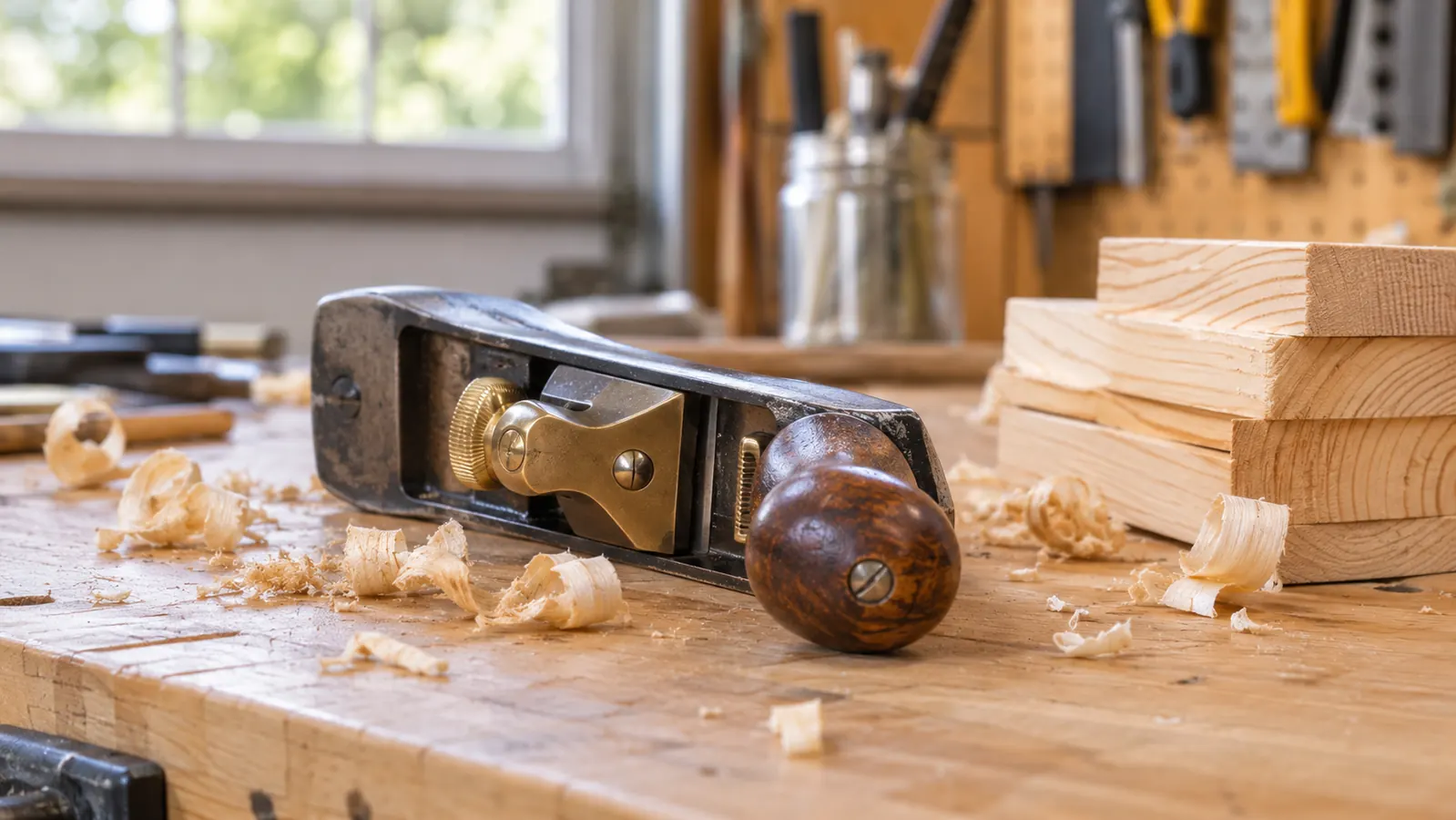
Twenty years ago, when I needed to break the sharp edge on a board, I tore a quarter sheet off the sandpaper roll and rubbed until my fingers ached. It worked. It also rounded the edge into something that looked nothing like a chamfer, and it left grit dust across the bench and down the front of my shirt. About eighteen months ago I set a JORGENSEN No. 60-1/2 on the shelf above the bench, and most of that sandpaper ritual stopped.
The plane is 6-1/4 inches long and weighs 1.5 pounds. It takes a 1.38 inch cut, the base is cast iron, and the blade is O1 tool steel. That is the whole tool. No battery, no cord, no fence to square up. It sits on the shelf on its side and comes down for the jobs that are too small to set a power tool up for and too fussy to leave to sandpaper. Plenty of tools do not survive a year on that shelf. This JORGENSEN block plane has.
The tool I reach for before the sandpaper comes out
Cast iron base, O1 tool steel blade, 1.38 inch cut, 1.5 pounds in the hand. Set the depth with the knob and take a shaving instead of a dust bath.
Amazon Check Today's Price on Amazon →It takes the fuzz off end grain instead of pressing it down
End grain is where a dull tool announces itself. A saw leaves the end of a board fuzzy, and sandpaper flattens that fuzz into a dull grey surface that never quite closes against its neighbor. A sharp plane slices it off clean. I cut picture frame stock four pieces at a time, and I used to spend the last stretch of that job sanding miters by hand. Now I clamp the four pieces together, run the plane across the ends, and the joints close with a line you have to look for.

1.5 pounds keeps one hand on the tool and one on the work
A long bench plane is a two handed tool. On a short board that means one hand does nothing but keep the nose from tipping, and you lose the feel of what the blade is doing. At 1.5 pounds I hold the work with my left hand and drive the plane with my right. That matters when I am trimming a drawer front to fit an opening that is a hair too tight. I can feel the plane start to tip before it digs, and I can stop and take a thinner shaving.
The depth knob adjusts without a hammer
Setting the cut on some old planes means tapping the iron with a hammer and hoping for the best. This one has a knob. I turn it a little, take a test shaving on a scrap of pine, and turn it again until the shaving is thin enough to read a pencil line through. When I come back to the job the next evening, the setting is still where I left it. No re-tuning, no tapping, no cussing.
A 1.38 inch cut is the right width for small parts
The cutting width is 1.38 inches, which sounds narrow until you notice what it is for. A drawer side is usually about half an inch thick, so the blade covers the whole edge in one pass with room left over. Same story with a picture frame molding, a chamfer on a step stool leg, or the front edge of a bookshelf. A wider plane on work this size is more tool than the job needs, and more tool means more of the cut running past the part you are trying to fix.
The cast iron base stays flat and does not chatter
Chatter is the skittering you feel when a plane bounces across the work instead of cutting it. It comes from a base that is not flat or a blade that is not held tight. The JORGENSEN has a cast iron base with a polished flat bottom, and the mass of it keeps the tool settled on the wood. On a narrow chamfer I get one continuous shaving instead of a row of divots I have to sand out afterward, which is the whole point of owning the plane in the first place.
The O1 tool steel blade takes an edge and holds on to it
The blade is O1 tool steel, a simple high carbon steel and a known quantity. It hones quickly on a diamond stone and it holds up through an evening of pine and poplar. I touch it up every third or fourth session, five or six passes on the fine side of the stone, and it is back to taking a shaving I can see daylight through. The blade that came in the plane is the blade I am still using eighteen months later.
Four passes replace ten minutes of sanding
I timed this because I did not believe the difference was real. Trimming the chamfer on four stool legs used to run about ten minutes of sanding, and I would still squint at it under the light and touch up one corner. With the plane set fine it is four passes per leg, and the chamfer comes out even along the whole length instead of drifting wider at one end. That is the gap between a job I put off all week and a job I finish before dinner.
Small enough to keep where the work actually happens
At 6-1/4 inches it does not need its own drawer or a spot on the pegboard. Mine lives on the shelf above the bench, on its side, and it comes down for jobs that take two minutes: easing the back edge of a shelf, taking a whisker off a tenon cheek, cleaning up a glue line before the finish goes on. A plane only gets used for two minute jobs if it is already within arm's reach. If it lives in a case under the bench, you will reach for the sandpaper instead.
Quiet enough for seven in the evening
My shop is one bay of a two car garage and the neighbor's kitchen window is maybe twenty feet from my bench. Running the table saw at seven at night is a fine way to become unpopular on the block. The block plane makes a sound like a zipper. I do my planing after dinner and save the loud work for Saturday afternoon. If your shop shares a wall with the house or sits close to other people, that quiet is worth more than it sounds on paper.
It teaches you what a sharp edge actually feels like
This is the part I did not expect. Once you have felt a plane take a clean shaving, you know what sharp means in your hands, and that carries straight over to your chisels and your saw. I spent years guessing whether an edge was good enough, then touching it up anyway just to be safe. Now I know within one pass. The blade on a block plane is small enough to get flat and sharp on a single stone, which makes it a reasonable place to learn if sharpening has been the thing holding you back.
What I'd Skip
Two things I would not do with this plane. I would not buy it to flatten a bench top or joint the edge of a six foot board. A 1.38 inch blade and a 1.5 pound tool are the wrong size for that work, and you will be there all night. And I would not buy any hand plane, JORGENSEN included, if you have no intention of learning to sharpen. Mine cut acceptably out of the box and cut well after fifteen minutes on a diamond stone. A dull blade in a good plane is worse than a sharp blade in a cheap one, and no amount of turning the depth knob fixes it.
Four passes per leg did what ten minutes with a sanding block used to do, and the chamfer came out even along the whole length instead of drifting wide at one end.
A tool earns its shelf space by getting picked up
The JORGENSEN No. 60-1/2 has been on my shelf about eighteen months and it comes down most weekends. If your bench is missing something between the saw and the sandpaper, this is the gap it fills.
Amazon Check Today's Price on Amazon →