
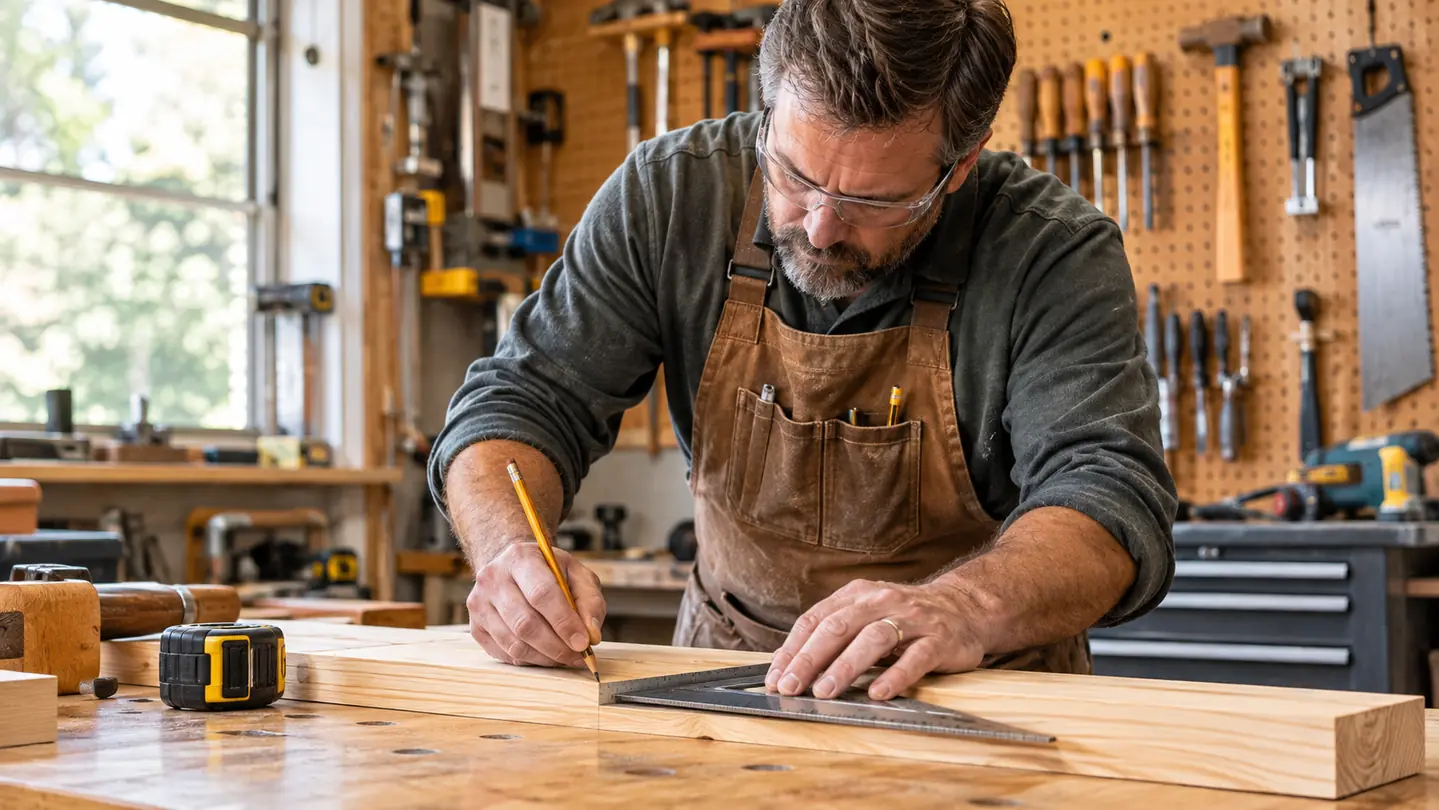
The cheap speed square is the first layout tool most of us buy. It hangs on a nail, it marks a 90 and a 45, and it gets you close enough for framing. I used one for years. Then I started building picture frames and a blanket chest, and close enough stopped being close enough. The IRWIN Combination Square is the tool that took its place for the work that has to come together tight. I bought mine about four years ago, and it hangs on the pegboard next to my pull saw. The short answer: the IRWIN is the better bench square for furniture and joinery, and a cheap speed square is still the better tool for rough cuts and one-handed marking. If you only want one, buy the IRWIN. If you want to work fast and rough, keep a speed square too.
Here is the difference in plain terms. The IRWIN has a 12 inch stainless steel blade, a metal body, precision-etched scales with 1/16 inch graduations, and 45 and 90 degree marking faces. It can be used as a gauge for transferring measurements, and it carries a limited lifetime warranty. A cheap speed square is a one-piece triangle. It does two jobs fast: a square line across a board and a 45 degree cut. It does not reach across a wide glue-up, and it does not give you a long, fine scale to read. That is the whole comparison. The rest is where each one earns its space in my garage shop in Fullerton.
| IRWIN Combination Square | Cheap speed square | |
|---|---|---|
| What it is | A 12 inch metal-body square with a stainless steel blade and 45 and 90 degree marking | A one-piece triangle for quick 90 and 45 degree marks |
| Reach across a joint | The 12 inch blade spans a frame, box, or step stool corner | The short body checks one corner at a time |
| Fine scale | Precision-etched scales with 1/16 inch graduations | Markings vary by model and are coarser on many cheap squares |
| Transferring a measurement | Can be used as a gauge for transferring measurements | Not made for setting and carrying a depth |
| Checking a glue-up | The blade reaches across the diagonals of a small case | Too short to tell you about the whole box |
| One-handed marking | Needs two points of contact, so it is slower in one hand | The fence hooks the board edge and stays put |
| Rough cuts | Accurate, but more fuss than a quick 90 needs | Fast to slap down and mark |
| Tool belt | A 12 inch blade is a bench tool | Small one-piece body rides in an apron pocket |
| Staying square after a drop | Metal body and stainless blade, with a limited lifetime warranty | A cheap square can bend, and there is no warranty to lean on |
| Warranty | Limited lifetime | No warranty stated |
| Upfront cost | More than a cheap speed square | The lowest-cost way to mark a 90 and a 45 |
Where the IRWIN Combination Square Wins
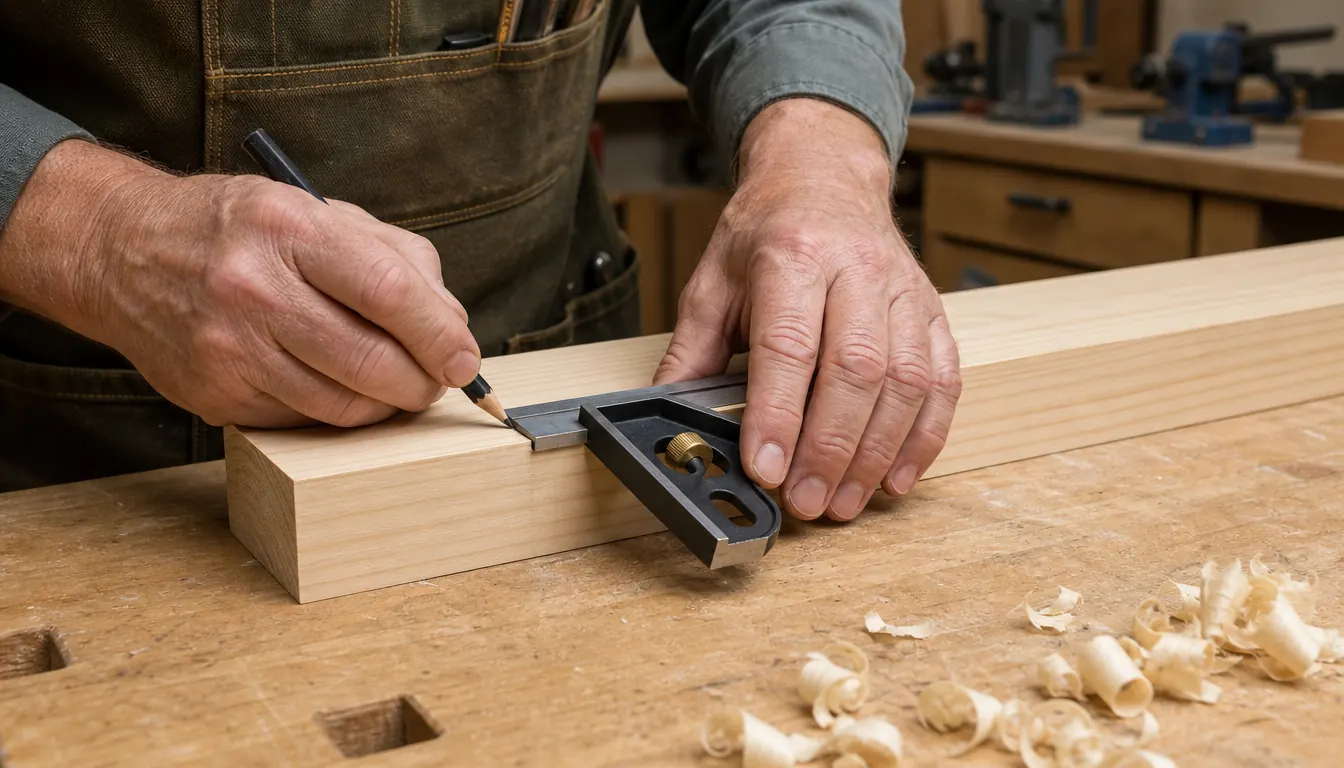
The first place the IRWIN wins is reach. A 12 inch blade laid across the corner of a picture frame or a blanket chest tells me whether the diagonals match. A speed square sits at one corner and stops. I can hook the head on an edge, slide the blade across a board, and mark a line that stays parallel. That is not a small thing when you are trying to get four sides of a frame to meet without a gap. The precision-etched scales are easy to read under my bench light, and the 1/16 inch graduations are fine enough for furniture work. I do not have to squint and guess at a 32nd.
The second win is repeatability. The IRWIN can be used as a gauge for transferring measurements. I set the head to a depth, hold it there, and use it to mark that same depth on four legs or six slats. A cheap speed square is not built for that. It is a triangle you lay on a board, not a gauge you set and carry to the next piece. After a few years, the IRWIN still sits flat on the bench and still reads the same against my try square. The limited lifetime warranty is not why I bought it, but it is why I did not think twice when I replaced the old square I had been using.
Where the Cheap Speed Square Wins
The cheap speed square wins on speed and one-handed work. The fence on the triangle hooks the edge of a board and stays there while you mark with the other hand. I can grab one, slap it on a 2x4, mark a 90, and make the cut before I would have the IRWIN head lined up. For breaking down pine for a step stool or cutting a stud, that is all I need. It also lives in an apron pocket without pulling my pants down. The IRWIN is 14.4 ounces and 12.4 inches long, so it stays at the bench. If I am working on a ladder or moving around the garage, the speed square is the one I want in my hand.
The other win is cost and not caring. A cheap speed square is the least expensive way to get a 90 and a 45. If it gets dropped, stepped on, or buried under a pile of offcuts, I do not lose sleep. The IRWIN is a bench tool, and I treat it like one. I do not toss it in a bucket of screws. On a rough job, the cheap square is the right tool because the job does not ask for a fine scale or a long blade. It asks for a quick mark, and the speed square gives it.
What the Specs Mean at the Bench
The 12 inch blade is the number that matters most. It is long enough to span the corner of a picture frame, a step stool, or a small box. It is not long enough to check a full sheet of plywood, and it is not meant to be. For a home shop, 12 inches covers most furniture parts. The stainless steel blade resists rust in a garage that gets damp in the morning. I have had mine for four years and I have not seen a spot of rust on it. I wipe it down with a rag when I am done, but I do not baby it.
The 1/16 inch graduations are the second number. For furniture, that is fine enough for most marks. I still use a pencil and a knife line for the last bit, but the square gets me to the line. The precision-etched scales are easier to read than the stamped markings on a cheap square. They have not worn off after four years of use. The 45 and 90 degree faces are the two angles I use most. I check 90 on every glue-up, and I use 45 for braces and frame miters. The square does both without a second tool.
The metal body and the 14.4 ounce weight make it feel solid on the bench. It does not slide around when I set it down. The 12.4 inch length and 5.51 inch width are the footprint you are storing. It hangs on a pegboard hook, and it does not take up drawer space. The limited lifetime warranty is the last number. I have not needed it. I have used other IRWIN tools long enough to trust that the warranty is there if a part fails. That is worth something when you are buying a tool you plan to keep.
How I Set Up a Cut With Each One
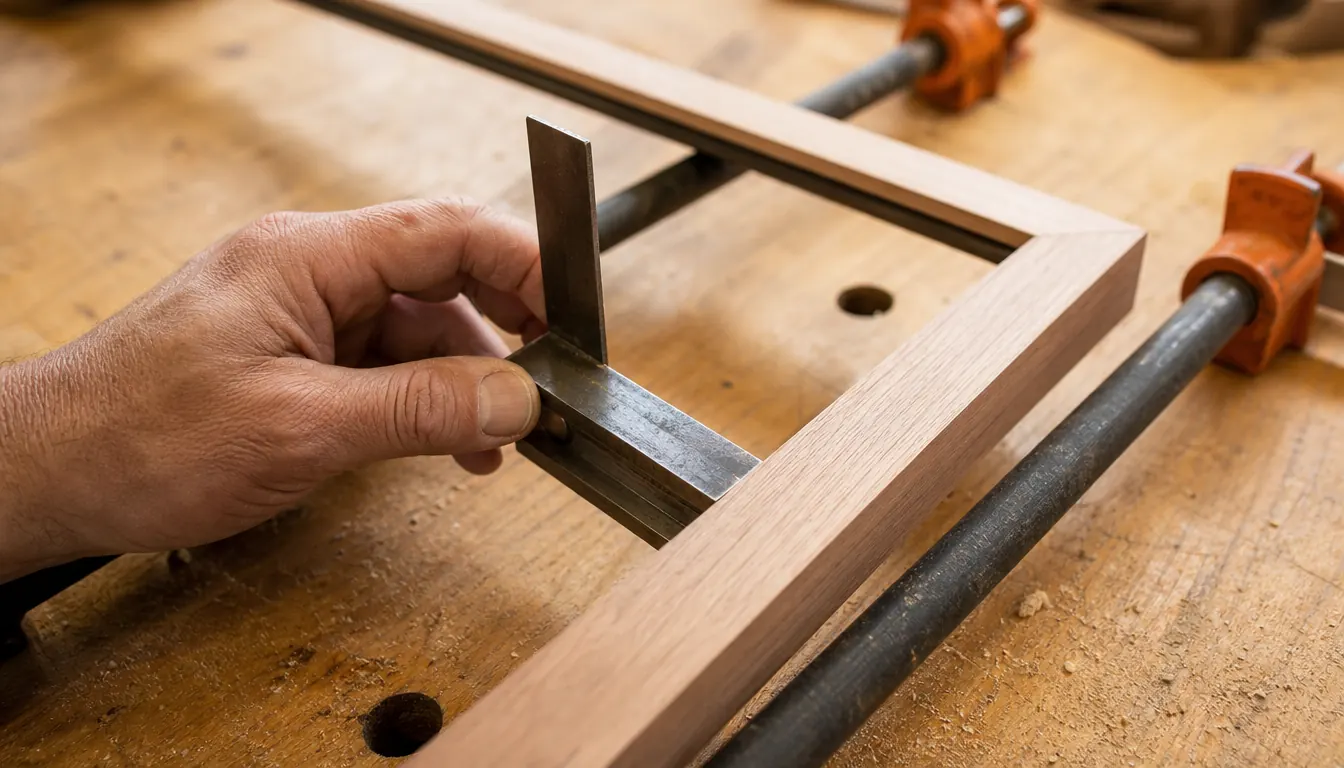
On a typical Saturday, I start with the IRWIN. I lay the blade across the board, set the head against the edge, and mark the cut line with a pencil. Then I check the line against the blade before I touch the saw. If the board is wider than the blade, I mark from both edges and check the two lines with the square. That extra step takes a few seconds. It saves me from a taper that shows up after the glue dries. For a picture frame, I use the IRWIN to check every corner and both diagonals. A frame that is out of square by a 16th will show at the miters.
On the same day, I use the cheap speed square for the rough cuts. I keep it near the saw for breaking down stock. I hook the fence on the board, mark a 90, and cut. If I need a 45 for a brace, the speed square has that angle built in. I do not try to check a glue-up with it. I do not try to transfer a depth with it. I use it for what it is good at, and I put it back. The two tools do not compete in my shop. They split the work.
The Mistake I Made With a Cheap Square
For a while, I tried to make one cheap speed square do everything. I used it to check the corners of a bookshelf I was building for a grandchild. I got the case together and the back would not sit flat. I checked it with the IRWIN and found the case was out of square. The speed square had been sitting on the corner, but it was too short to tell me what the whole case was doing. I had to take the back off and pull the case back into line. That was my mistake, not the square's. A short triangle can only tell you about the corner it touches. It cannot tell you about the whole box.
The other mistake was reading the scale. A cheap speed square has markings, but they are not the same as a 12 inch blade with 1/16 inch graduations. I was trying to mark a 3/4 inch offset on a leg and I read the wrong line. The cut was off, and I had to glue a patch on a piece that was supposed to be finished. Since then I use the IRWIN for any mark that has to be exact. I use the speed square for marks that have a little room. That rule has saved me more than once.
The IRWIN did not make me a better woodworker. It made my mistakes easier to see before the glue set.
If the joint has to close tight, use the square that spans the whole corner
The IRWIN Combination Square gives you a 12 inch stainless steel blade, precision-etched scales with 1/16 inch graduations, 45 and 90 degree marking, and a limited lifetime warranty. It is the square I reach for when a short triangle cannot tell me the whole story.
Amazon Check the IRWIN Combination Square on Amazon →Who Should Buy Which
Buy the IRWIN Combination Square if you build furniture, frames, boxes, or anything that has to go together square and stay that way. Buy it if you are setting up a first bench and want one square that can mark, check, and transfer measurements. It is also the better choice if you are tired of guessing whether a case is square because your only square is a short triangle. The 12 inch blade and the 1/16 inch scale are the two features that matter most in a home shop. The metal body and limited lifetime warranty are the reasons it stays on the pegboard instead of in a drawer.
Buy the cheap speed square if you mostly break down stock, frame, or work on a ladder. It is faster one-handed, it fits in an apron, and it does not mind being dropped. If you already own one, keep it. Do not throw it away when you buy the IRWIN. Use the speed square for rough cuts and the IRWIN for the joints. That is the setup in my garage, and it has outlasted every tool fad I have tried. The IRWIN is not the only square you will ever need, but it is the one I would buy first if I were starting over.
One square for the joints, one for the rough cuts
If you want the square that checks the whole joint, get the IRWIN Combination Square. Keep the cheap speed square for the fast marks. That is how I set up my bench, and it has kept me from gluing up an out-of-square box more than once.
Amazon See the IRWIN Combination Square on Amazon →