
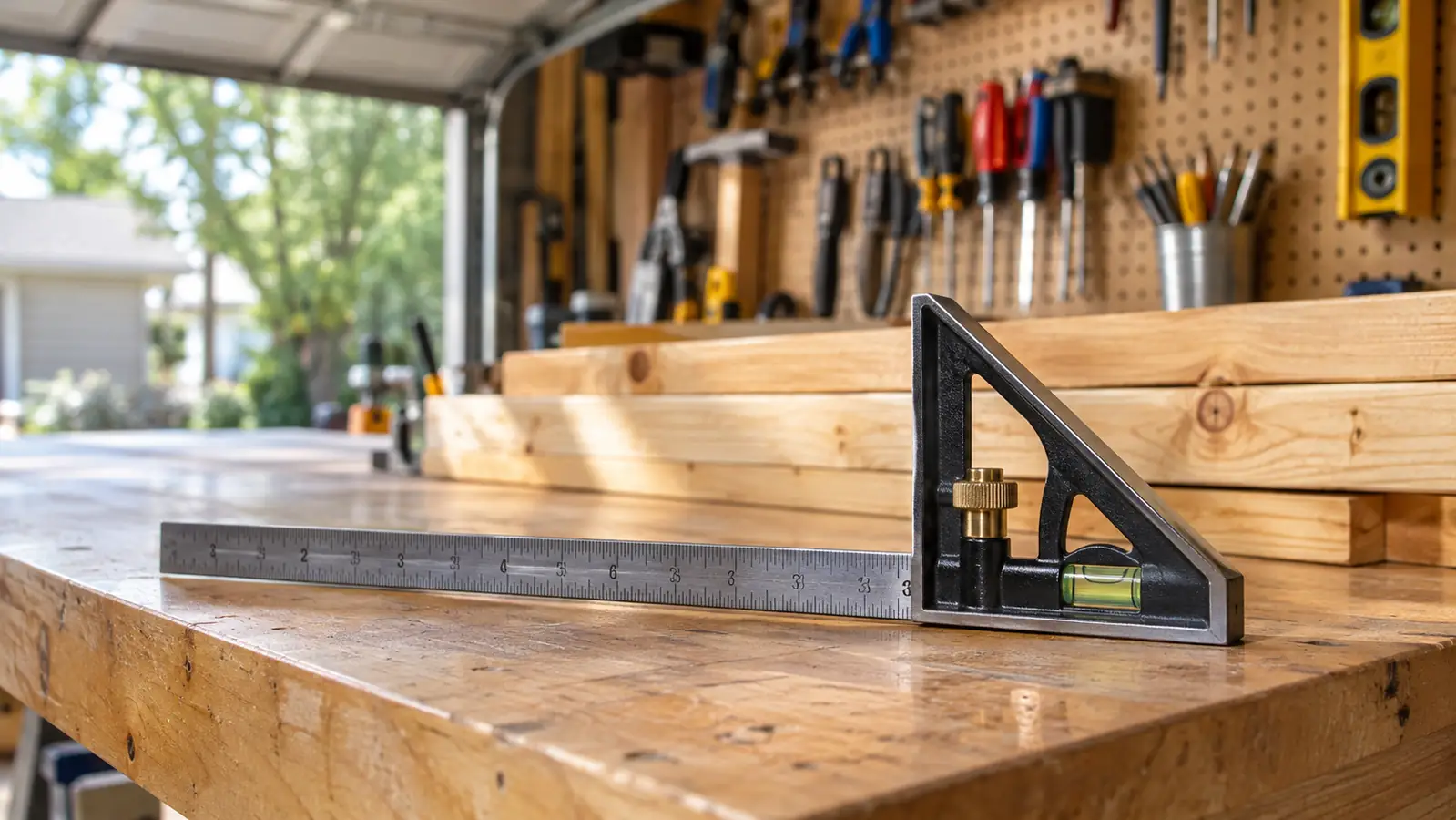
The first combination square I owned came out of a clearance bin and cost less than lunch. The head wobbled. The numbers wore off the blade after one summer. For years after that I marked cut lines with a pencil and a tape measure, because at least I knew exactly how wrong I was being. About four years ago I bought the 12-inch IRWIN combination square, hung it on the pegboard next to my pull saw, and stopped guessing where my cut lines were.
I am not a cabinetmaker and I am not going to pretend otherwise. I am a retired plant maintenance mechanic with one bay of a two-car garage in Fullerton, a bench I built myself out of maple, and somewhere around fifteen hours a week to spend at it. My materials are pine, poplar, some oak, a little walnut when Carol lets me buy it. My projects are step stools for the grandkids, picture frames, cutting boards, and a bookshelf that took me a lot longer than it should have. That is the lens this review comes through. If you want a report on how the IRWIN holds up to eight hours a day of production cabinet work, I cannot give it to you. Four years of weekends, I can.
The Quick Verdict
The 12-inch IRWIN does three jobs I used to fake with a pencil: it marks a line I can actually cut to, it tells me when a glue-up has gone out of square, and it sets a depth at the table saw. Four years in, mine still reads square. The scales are the weak point on dark wood.
Amazon Check Today's Price →Four years of weekend cuts and it still reads square
It hangs on the pegboard and comes down on almost every project. One tool for marking, checking and setting depth instead of three. Limited lifetime warranty on the head.
Amazon Check Today's Price on Amazon →How I've Used It
The square hangs on a pegboard hook at shoulder height, between the pull saw and my safety glasses. That spot is deliberate. Almost every cut I care about starts with a line I have to trust, and the line starts here. The 12-inch blade reaches across the face of just about anything I build. On a wider glue-up I use the square as a gauge and walk it along the panel, which takes longer than a tape measure but gets me a line I believe instead of a line I hope for.
Picture frames are where it earns its keep. A mitered corner is either 45 degrees or it is firewood, and the head on this square gives me that angle without hunting around for a protractor I would have to find first. When a frame comes out with a gap at one corner, ten seconds with the square tells me whether the problem is the miter itself or a rail that ended up a fraction long. That used to cost me twenty minutes of squinting and a fair amount of language Carol pretends not to hear from the house.
The third job is depth, and it is the one nobody mentions when they tell you to go buy a combination square. When I need a groove or a rabbet to a set depth on the table saw, I take the blade height off the square instead of eyeballing it against a rule. Same when I am marking a line at a fixed distance in from the edge of a cutting board. Slide the head to the number, snug it down, drag it along the board. That is all a gauge really is, and it is the reason this tool stays out on the bench instead of going back in the drawer with the rest of them.
One more use I did not expect: checking the table saw. When I change a blade or bump the trunnion, I want to know the blade sits square to the miter slot before I cut anything that matters. I lay the square flat on the table with the head against the slot and look for light under a tooth. It will not catch a couple thousandths. It catches the quarter degree that ruins a mitered frame, and that is the size of mistake I actually make.
What the Etched Scales Actually Get You
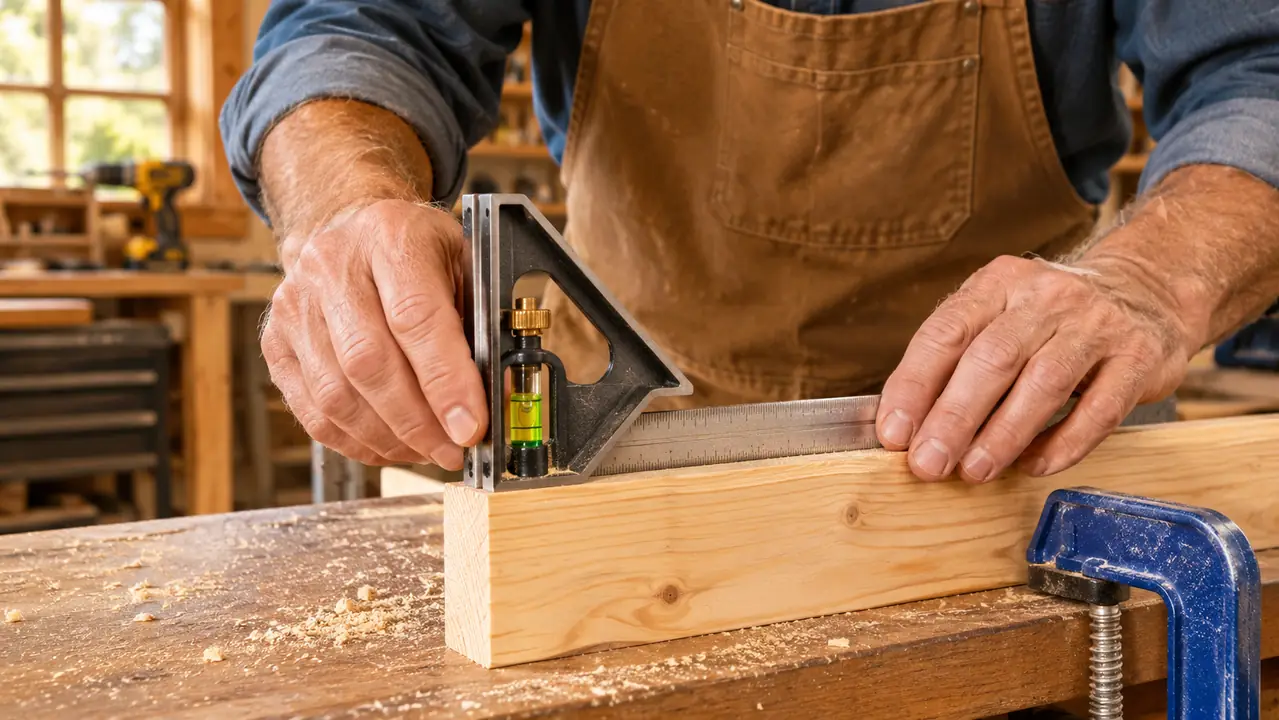
The markings on this blade are etched into the metal rather than printed on the surface, and after four years of handling they are still there. That sounds like a small detail until you have owned a square where it is not true. The graduations run to 1/16 inch, and that is where the tool stops for me. If your work needs 1/32 or finer, and some furniture joints genuinely do, this is not the square for that job. For a pencil line and a saw kerf, 1/16 is honest and it is enough.
The 45 degree face gets more use than I expected. Frames, and any mitered corner in a case, and the angle is right there on the head with nothing to set up. The first few frames I built, I trusted my miter gauge to be at 45 and got corners with a gap you could see from three feet away. Setting the angle off the head instead got me joints that closed with glue and needed no filler.
The blade itself is stainless steel. Mine has picked up the faint surface spotting you get from a garage with the door open in Southern California, but nothing that has turned into pitting. The listing calls it rust proof. I would call it rust resistant and leave it there, because I have never left mine out in the rain and I do not intend to start now. A quick wipe with a rag when I put it away has been the whole maintenance routine for four years, and it seems to be working.
The body of the head is metal, which matters more than I expected it to. The square this one replaced had a head that warped the first hot summer it lived in the garage, and a warped head is worse than no square at all because it lies to you with confidence. Metal does not do that. It also survives being knocked off the bench, which I have done twice, both times reaching for something else and both times saying a word the neighbors could probably hear. The 45 and 90 degree faces have not deformed at all that I can measure.
Four Years On: How It Has Held Up
The way I check a square is the flip test. Hold the head against a straight edge, mark a line along the blade, flip the square over and mark again from the same edge. If the two lines are one line, the square is true. If they open up into a wedge, it is not, and no amount of wanting it to be will change that. I do this about twice a year, usually when a joint comes out wrong and I am hunting for something to blame. Four years in, mine still draws one line. Two drops onto a concrete floor and it still draws one line.
The quicker check I run before any project that matters is simpler than that. I hold the head against the machined edge of my bench top and look for light between the two faces. One gap in four years, and it turned out to be a burr on the bench edge, not the square. I filed the burr off and stopped doubting the tool.
The screw that locks the head needs a firmer snug than it did the first year. Not a lot, and it has never slipped mid-mark that I could point to, but I notice it and I am telling you because you would notice it too. I tightened it down, kept working, and put it out of my mind. The listing carries a limited lifetime warranty. I have never had to use it, so I cannot tell you how that conversation goes, only that it is written there on the listing.
Where It Falls Short
The scales are the honest complaint. On a piece of dark walnut under garage lighting, 1/16 marks are work to read, and I have caught myself leaning in with a flashlight more than once this past winter. A lighter blade would be easier on old eyes. Whether that is worth giving up the etched markings, I could not tell you, but it is a real tradeoff and I would rather say so than pretend the tool is perfect. If most of your stock is dark hardwood, budget for a small light over the bench.
The worst of it came in December, on a walnut box for Carol's sister. Dark stock, one shop light, and I spent twenty minutes marking the same joint twice because I kept losing my place in the graduations. I taped a scrap with a pencil line to the blade as a reference and stopped counting ticks. The square was fine. I was asking it to work in light it was not built for.
Second, 12 inches is 12 inches. Layout on a full sheet of plywood or across the carcass of a chest means walking the square along or falling back on a tape measure, and walking it along introduces its own small errors if you are not careful. Third, this is a good square, not a machinist's square. If your measuring lives in thousandths, buy something built for that. And if you only ever crosscut 2x4s to length for shop fixtures, a speed square will do the job faster and you should not let me talk you into more tool than the work needs.
What I Liked
- Etched scales are still legible after four years of handling
- Metal head has not warped or drifted in a hot garage
- Marks 90 and 45 degrees and sets depth with one tool
- Stainless blade has not pitted with basic wiping
- Still passes the flip test after two drops on concrete
Where It Falls Short
- 1/16 inch is the finest graduation it goes
- Scales are hard to read on dark wood in poor light
- 12-inch reach means walking it along on sheet goods
- Head lock needs a firmer snug than it did when new
Two drops on a concrete floor and mine still draws one line on the flip test. I could not say that about the square it replaced.
One Project, Start to Finish
The clearest way to describe what a tool does is to walk it through a job. Last spring I built a small bookshelf for my granddaughter. Pine, three shelves, about thirty inches tall, nothing complicated. Every cut on that shelf started with the IRWIN. I set the blade to a hair over the finished width, marked both faces of each shelf so the line would carry around the edge, and used the square as a gauge to keep the marks a consistent distance apart down the length of the stock.
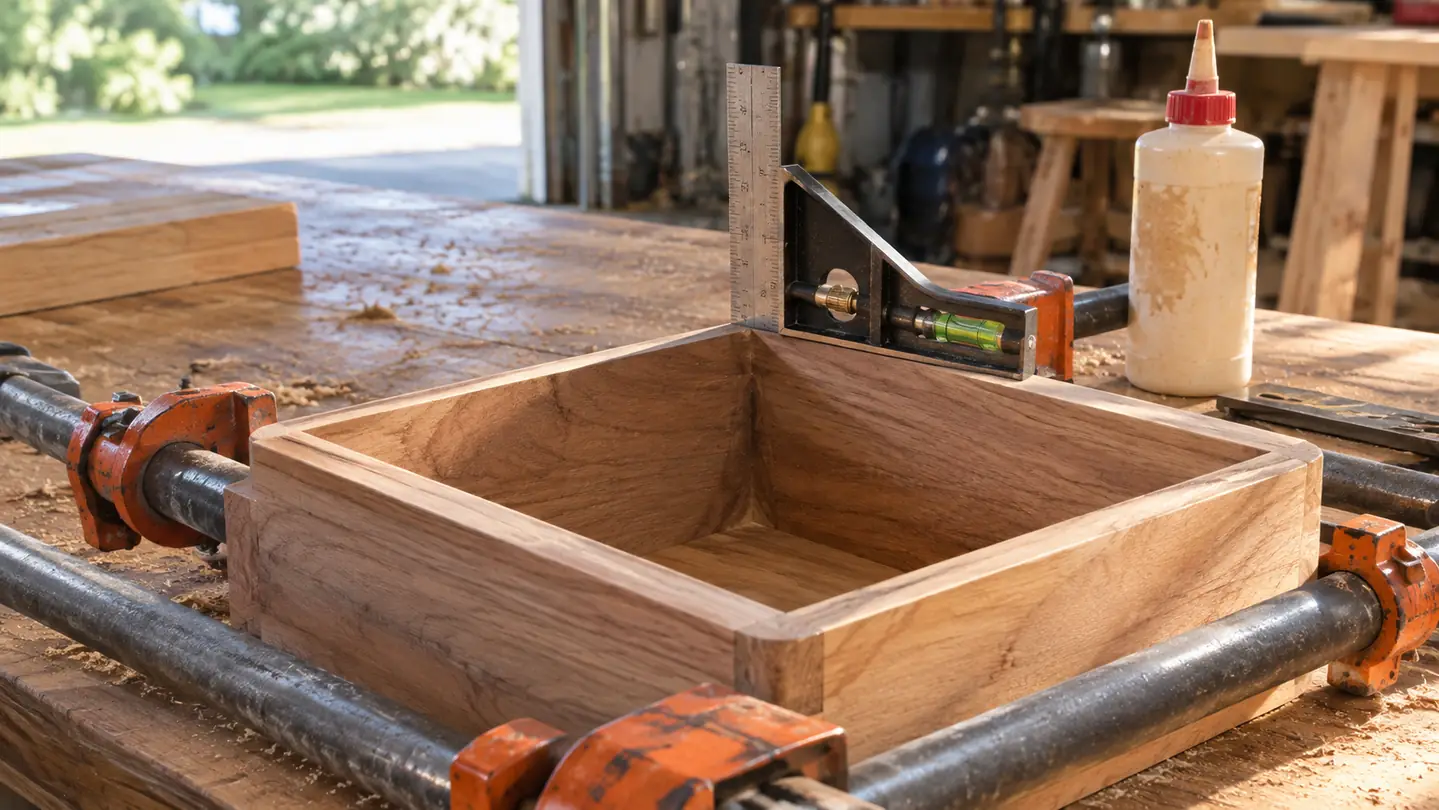
Where it changed the job was at glue-up. A pine case like that will pull itself out of square if you look at it wrong, and once the clamps go on you have about four minutes to argue with it. I set the square into the inside corner, checked it front and back, and adjusted the clamps before the glue grabbed. When the case came out, it was square enough that the back panel dropped in without a fight and the shelves did not need to be forced. That is not a dramatic story. It is the entire value of the tool, and it is boring in exactly the way you want.
The mistakes I made on that shelf were mine, not the square's. I marked one shelf from the wrong reference face and cut it 3/16 long. I caught it because I rechecked before glue, not because the tool told me anything. A square does not think for you. It just stops you from being wrong about square, which is one fewer thing to hold in your head while you are also trying to remember which clamp goes where.
Who This Is For
This is the square for the person who builds on weekends and wants one marking tool they do not have to re-buy. If you are framing a shed or laying out a deck, the 12-inch IRWIN will do the work accurately, though a speed square is faster to grab. Where it really belongs is on the bench of somebody making furniture and fixtures, where 45 degree miters and square glue-ups come up on every project and a wobbly head will cost you a frame. If you are setting up a first bench and buying tools one at a time, this goes on the pegboard early, before several things that cost more and get used less.
It is also the square I would hand someone learning to mark a line. The head locks where you put it, the graduations are big enough to actually read, and if it gets dropped on the driveway it is not the end of the world or the end of your afternoon. Tools that survive being treated like tools get used, and tools that get used get better results than tools that live in a box under the bench.
Who Should Skip It
Skip it if your work regularly runs finer than 1/16 inch, because you will fight the graduations every time and blame the tool for a limit you knew about going in. Skip it if you need to lay out across a four-foot panel and want to do it in one pass, since a 12-inch blade is not that tool and no amount of wanting will make it one. Skip it if you are framing and want speed. And skip it if what you actually want is a machinist's square, because this is not one and does not claim to be.
The square I would buy again tomorrow if this one walked off the pegboard
Marks 90 and 45 degrees, sets a depth, and the etched scales are still legible after four years. Bought with my own money, hanging on my own hook, used on almost every project that leaves this bench.
Amazon Check Today's Price on Amazon →