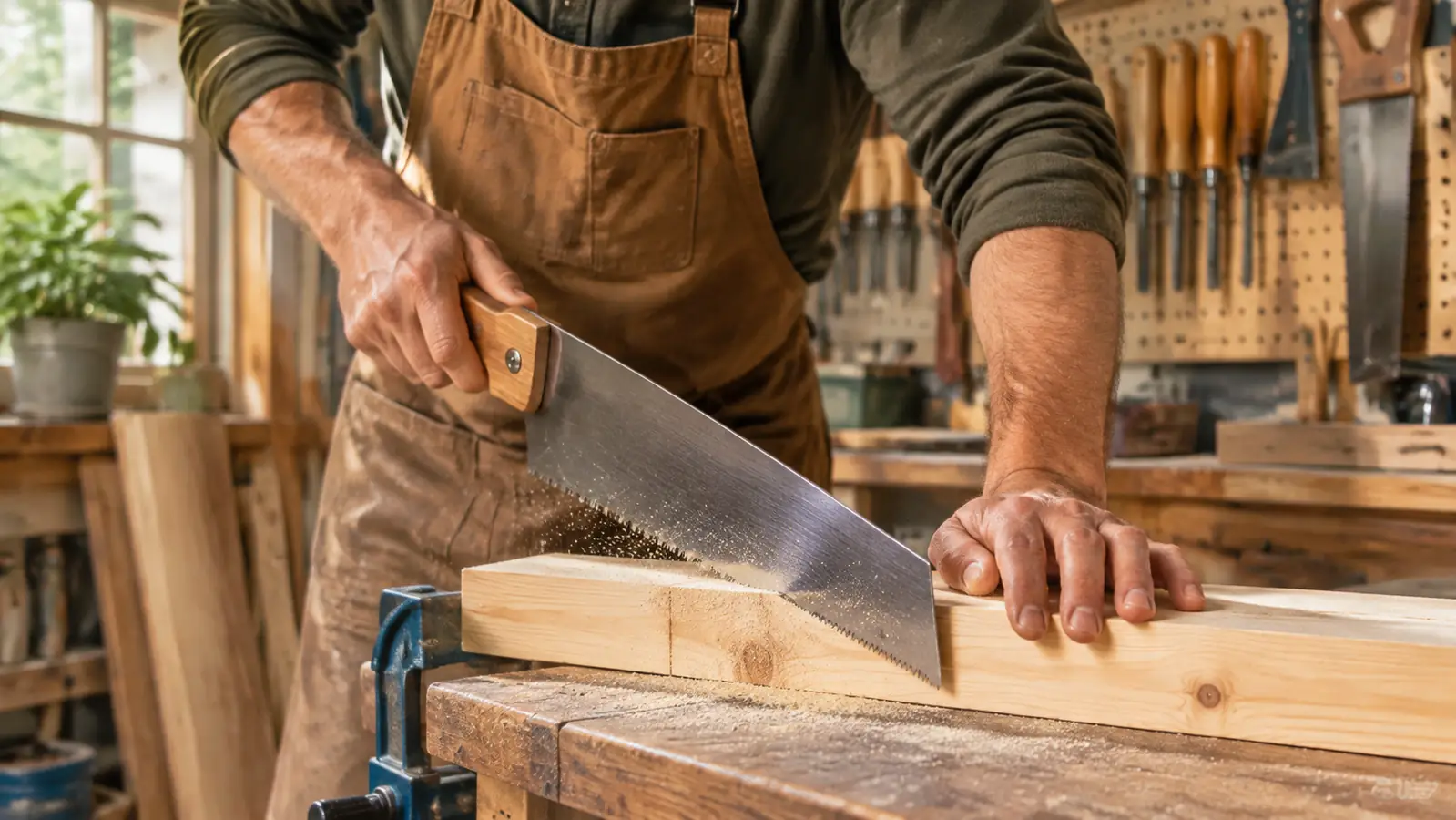
I bought the SUIZAN 9.5 inch ryoba about three years ago, mostly because I was tired of fighting a western backsaw in a garage shop that is about 11 by 20 feet. I am Russ Penhallow, 63, a retired plant maintenance mechanic in Fullerton, California. My bench is a six-foot maple-top I built myself, with a front vise and a pegboard wall behind it. The SUIZAN hangs there now, between the combination square and the block plane. It has cut tenons for a blanket chest, trimmed dowels on picture frames, and broken down small pieces of oak and poplar for step stools. It is not the only saw I own. It is the one I reach for when I want a clean line and do not want to wake the neighbors with a power tool.
This is not a spec sheet love letter. The saw has limits, and I will get to those. But if you are setting up a first bench or adding one hand saw to a garage shop, these are the ten reasons the SUIZAN ryoba earned its peg.
The saw that hangs by my bench, not in a drawer
4.8 stars from 9,821 reviews. Hand powered, with rip teeth on one edge and crosscut teeth on the other.
Amazon Check Today's Price on Amazon →Ten Reasons It Stays on the Pegboard
The pull stroke keeps the blade tracking where I aim it
A western backsaw cuts on the push stroke, so a beginner tends to steer with muscle. The SUIZAN cuts when I pull, which keeps the blade in tension and makes it easier to follow a marked line. I noticed it most on the first tenon I cut for a blanket chest. The saw started in the waste area and stayed there. I still miss the line sometimes. I just miss it less.
Two tooth patterns in one saw, rip on one edge and crosscut on the other
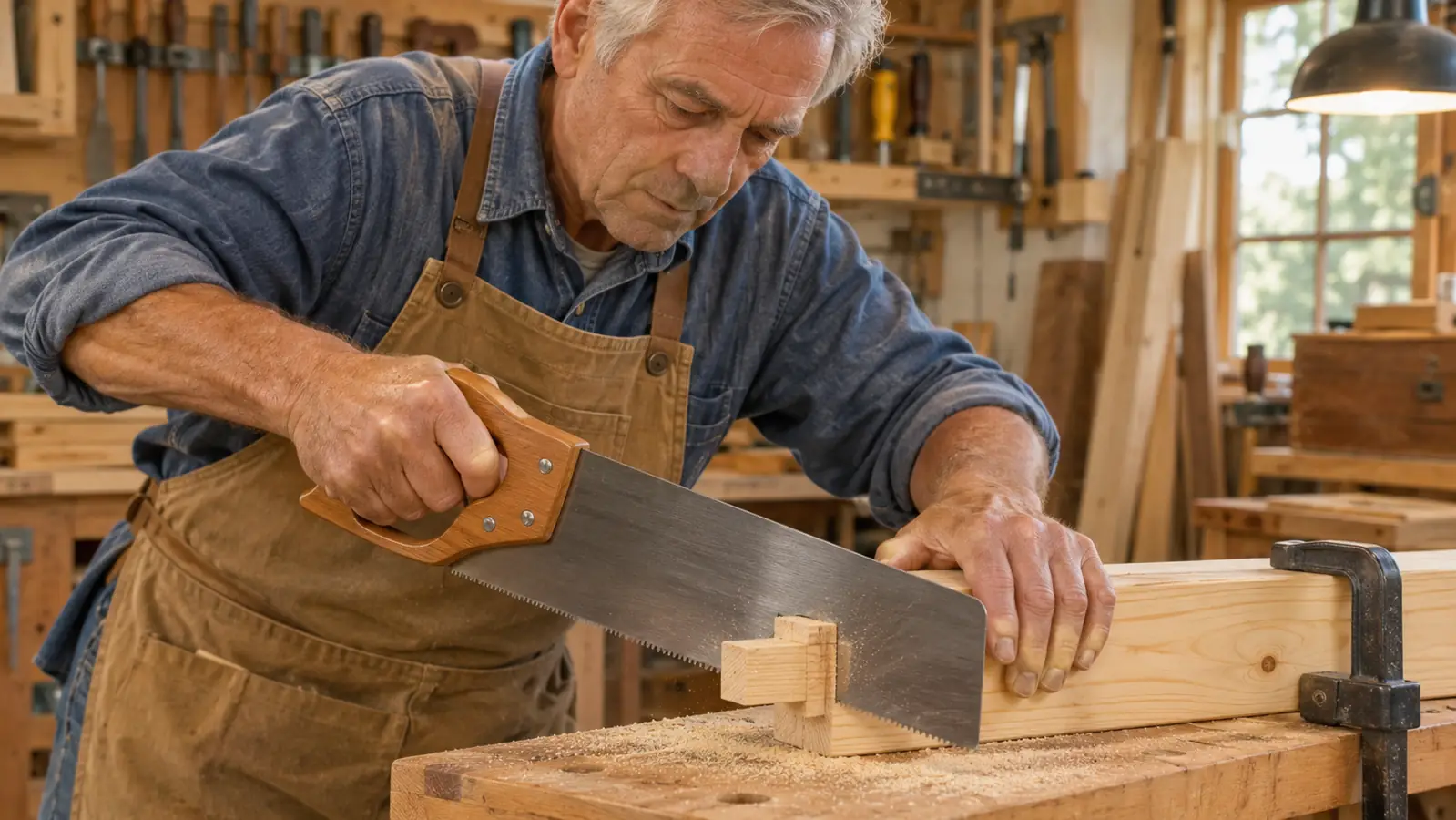
The SUIZAN ryoba has rip-cut teeth at 9 TPI on one edge and fine crosscut teeth at 15 TPI on the other. That means I do not have to walk to the pegboard for a second saw when a tenon needs cheeks and shoulders. I cut the cheeks with the rip side, flip the saw, and cut the shoulders with the crosscut side. One tool, two jobs, less bench clutter.
A 0.03 in kerf leaves more of the board for the project
The blade is 0.02 in thick and the kerf is 0.03 in. On a picture frame or a small box, that narrow cut means less wood turns into sawdust. It also makes a tight fit easier to close with a block plane. I am not weighing sawdust at the bench, but I do notice that small parts come out closer to the size I marked.
The fine crosscut teeth leave a surface I can work from
The crosscut edge has 15 TPI, and the listing says it leaves a smooth surface in hardwood and softwood. My experience matches that on poplar and oak. After a crosscut on a picture frame rail, I needed a light pass with the block plane, not a rescue. The cut line was clean enough that I could see where the plane was taking wood.
It starts a cut on a marked line without a lot of drama
I am not a fan of saws that skate across the board while I am trying to find the line. With the SUIZAN, I can set my thumb as a fence, take a few light pulls, and let the teeth settle into the mark. The pull stroke helps here too, because the blade is not being pushed away from the line. It is a small thing that saves a lot of second-guessing.
It is the saw I grab for tenons and dovetails
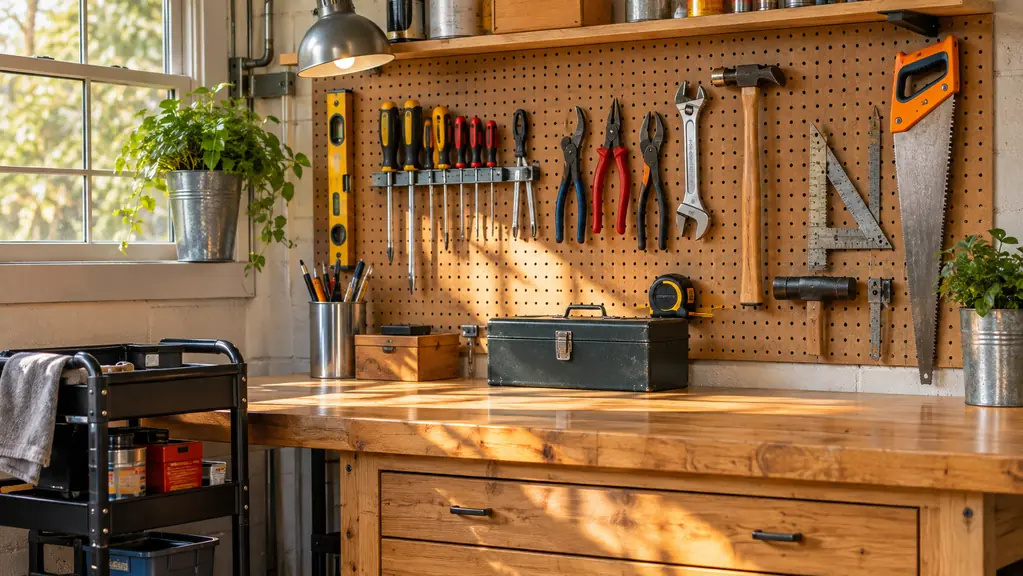
Rip teeth for the cheeks, crosscut teeth for the shoulders, and a 9.5 inch blade that fits inside a small layout. That combination is why the SUIZAN stays by the bench when I am cutting joinery. I am not a professional cabinetmaker, and my dovetails look like it. The saw still gives me a square shoulder to pare to with a chisel.
Flush trimming dowels and pegs is a two-minute job
After glue-up on a step stool, I had three dowels standing proud of the surface. The fine crosscut teeth and a light pull took them down without gouging the pine around them. I finished with the block plane. This is not a job I look forward to with a backsaw. With the SUIZAN, it is one of the few tasks in the shop that goes faster than I expect.
It hangs on the pegboard and weighs 0.2 kg, so it is always at hand
The saw is 23.2 inches long overall and weighs 0.2 kg. It hangs on a peg next to my combination square, and the blade guard goes back on when I am done. I do not have a big shop, so a tool that lives on the wall instead of in a drawer gets used more. That sounds like a small point. In practice, it is the whole reason the saw stays in rotation.
One screw holds the blade, so a replacement is not a shop project
The blade is held by one screw. Loosen it, fit a SUIZAN 9.5 in Ryoba replacement blade sold separately, and tighten. I have not needed to replace mine yet, but I like knowing the handle does not become scrap when the teeth wear out. It is a simple design, and simple is what I want in a hand tool.
It is quiet enough for a garage shop with close neighbors
My shop is one bay of a two-car garage. The table saw and cordless drill do the heavy work, but the SUIZAN lets me make a few cuts after dinner without announcing it to the block. It is hand powered, with no cord and no motor. For a hobby woodworker in a residential neighborhood, that quiet is not a small feature. It is the difference between a ten-minute project and no project at all.
What I'd Skip
I would skip the idea that this saw replaces every backsaw or every power tool. The SUIZAN is a 9.5 inch ryoba with a 0.02 in blade, and I would not use it to break down construction lumber all afternoon or cut a sheet of plywood. I would also skip forcing a dull blade. The warranty is 30 days, and replacement blades are sold separately. If you are framing a shed, use a circular saw. For furniture-scale work, this saw earns its peg.
The 0.03 in kerf is the detail I notice at the bench: less wood removed, less cleanup, and a cut that needs a plane, not a rescue.
If you have one saw peg left, make it this one
The SUIZAN 9.5 inch ryoba has rip teeth on one edge, crosscut teeth on the other, a 0.02 in blade and a 0.03 in kerf. It is the hand saw I use for tenons, dowels and small parts in a garage shop.
Amazon Check Today's Price on Amazon →